
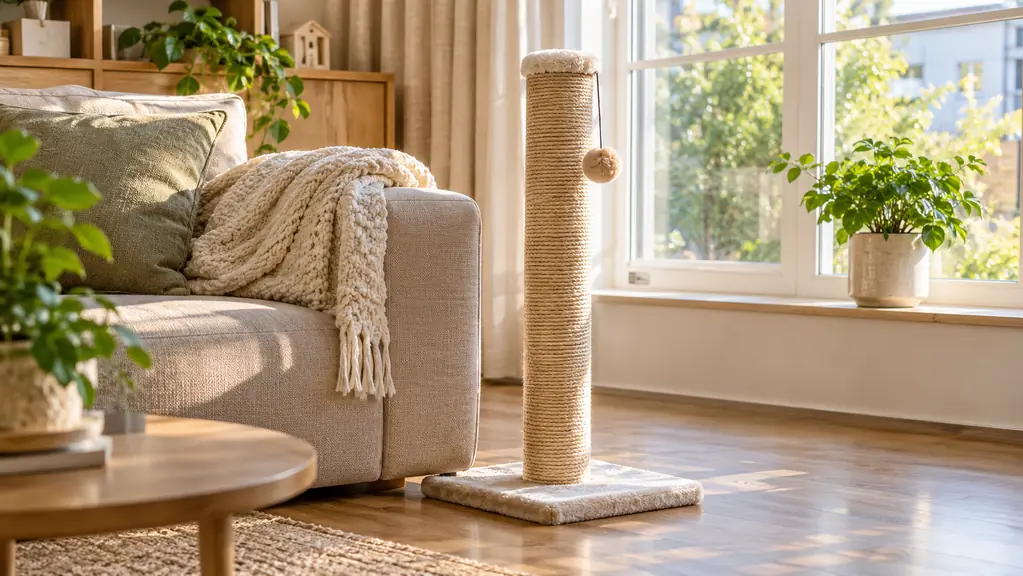
Two years ago my orange tom Moose picked the arm of my living room sofa as his scratching post. He is sixteen pounds and he does not scratch politely. I bought the SmartCat 32-inch post that same week out of pure self-defense and set it at the end of the sofa, directly over the damage. It has not moved since. The sisal is worn flat in two long patches now, and the sofa arm has grown its cover back. That is the short version of this review.
The longer version is where the useful part lives. A scratching post is one of those purchases where the five-star reviews tell you it works and the one-star reviews tell you it fell apart, and neither tells you what two years with a big cat actually does to one. So I want to walk through the parts nobody mentions: the weight of the thing, the size of the base, the assembly, what sisal looks like after a thousand mornings, and the one design detail that still irritates me. Then you can judge the value for yourself.
The Quick Verdict
Heavy, plain, and still standing after two years of a sixteen-pound tom throwing his whole body into it. The SmartCat post is the rare cat purchase I have not had to repeat.
Amazon Check Today's Price →Two years of morning scratching and the sisal is still tight
Thirteen and a half pounds on a sixteen-inch base. Mine has not tipped once, and Moose has tried.
Amazon Check Today's Price on Amazon →How I've Lived With It
I am sixty-six and I live in a one-story ranch house in Grand Junction, Colorado, that my late husband and I remodeled room by room. That means I have opinions about how furniture goes together, and I notice quickly when it does not go together well. The living room has laminate flooring and a big sunny front window, and the post stands at the end of the sofa in the path between that window and the kitchen. It gets bumped by passing knees. Twice a year I drag it out to sweep underneath.
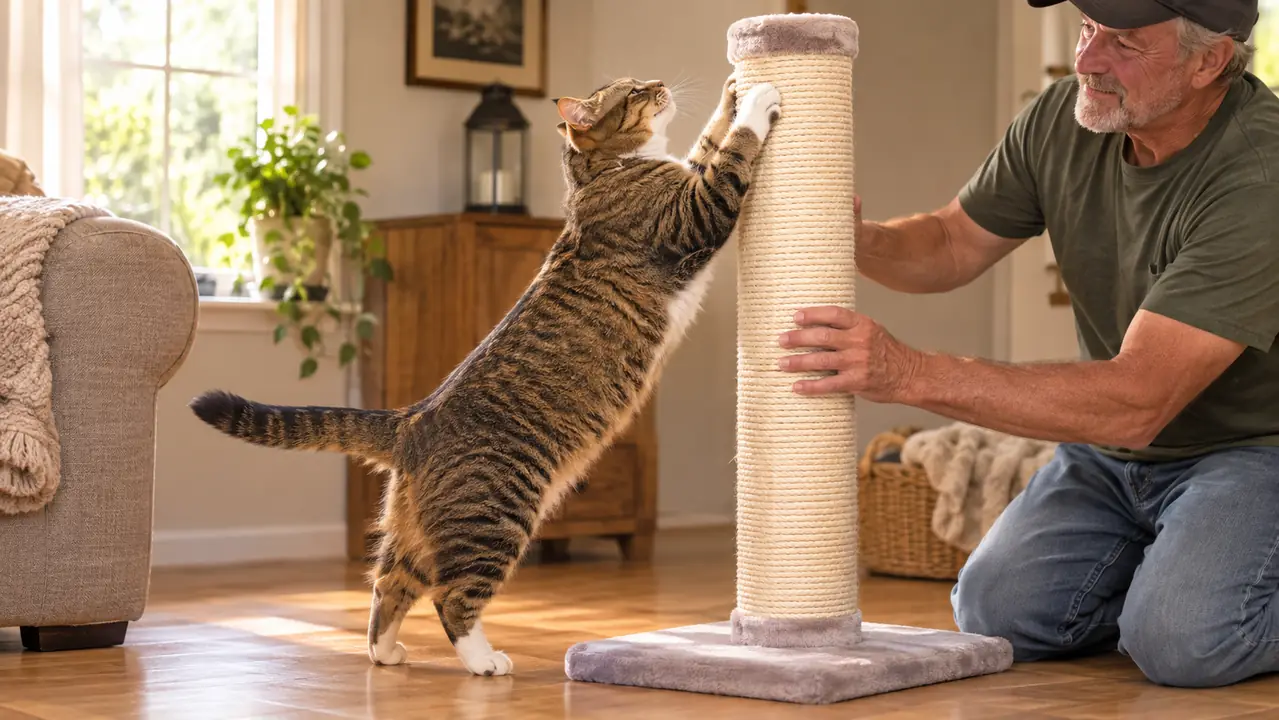
Moose uses it every morning before I have my coffee, and he uses it the way a big cat uses a post. He stands up on his hind legs, hooks both front paws in, and pulls down with his whole weight. That downward pull is what kills most scratching posts. Pepper, my nine-year-old tabby with hips that have gone stiff this past year, uses it now and then for a standing stretch and then walks off. She has never tried to climb it. There is nothing to climb, which is a point in its favor as far as the tipping question goes.
So my test has been the hard one. A sixteen-pound cat who scratches daily for two years is a fair stress test, and a post that comes through that will come through most cats for a good long while. The grandkids trooping through the living room have not knocked it over either, and they have knocked over nearly everything else in this house at one time or another.
What Comes in the Box, and How Long Assembly Really Takes
The box is heavy, and I want to say that up front because it matters more than people expect. The post weighs thirteen and a half pounds and stands thirty-two inches tall on a base measuring sixteen inches by sixteen inches. Nothing about those numbers is flimsy. The delivery driver set the box on the porch and I slid it inside rather than lifting it.
The box itself is nothing fancy, plain corrugated cardboard with the post wrapped inside, and everything in it is accounted for on the first look: the post, the base, two screws, two dowels, and a sheet of instructions short enough to read standing up. I have opened cat furniture boxes where the hardware came loose in an unlabeled bag and the directions were drawings of drawings. This is not that. I laid the pieces out on the living room floor, set my coffee on the end table, and was finished before it went cold.
Assembly is two screws, two dowels, and that is the whole job. Everything you need comes in the box. I did it myself on the living room floor with a screwdriver in about ten minutes, instructions propped against the sofa cushion. There is no bag of forty bolts, no cam locks, no fold-out diagram covered in arrows. If you have ever assembled a cat tree and considered throwing it through a window, this will feel like a vacation.
The only advice I would give is to put it together near where you plan to keep it. Once assembled it is a solid lump, and dragging thirteen and a half pounds across laminate by yourself is awkward rather than impossible. I assembled mine in the kitchen and walked it into the living room in short stages, which worked fine and did not hurt my back.
Why the Weight Is the Whole Point
Every scratching post that has ever gone over on one of my cats went over because it was too light. A cat launching at a post applies a startling amount of sideways force, and a three-pound post on a small base loses that argument every single time. The post tips, the cat gets startled, and now you own a piece of furniture the cat will not touch. That is how a cheap post ends up in the garage.
Before this one I had a lighter post from a big-box store, the kind with a small round base and a carpeted column. It weighed maybe four pounds, and Moose hit it the first week, it went over with a bang, and he left the room and never went near it again. I stood it back up twice and he avoided it both times, which told me everything I need to know about how a cat keeps score. That post went to the garage and eventually to a donation pile. The one at the end of my sofa has never given him a reason to keep score.
The SmartCat post does not do that. Thirteen and a half pounds on a sixteen-inch square base means Moose can throw his full weight into it and nothing moves. I have watched him do it hundreds of times. The post rocks perhaps a quarter of an inch and settles back. That stability is the single biggest reason this post is still in my living room while the cardboard scratchers are not.
It is also the reason it is not the easiest thing to live with. This is not a small decorative piece. It is thirty-two inches of post on a wide floor footprint, and it looks like exactly what it is. The maker describes the design as easy on the eyes and neutral enough to sit alongside your furniture. I would call it honest. It does not embarrass my living room, but nobody has ever walked in and asked where I found the lovely sculpture.
Thirteen and a half pounds on a sixteen-inch base. Moose throws his whole body at it every morning and it does not move.
The Sisal, Two Years In
This is the part that matters most and the part a review written in the first week cannot tell you. Sisal wears. It is supposed to wear. The real question is whether it wears into a rougher, more useful surface or shreds into loose strings and bald patches.
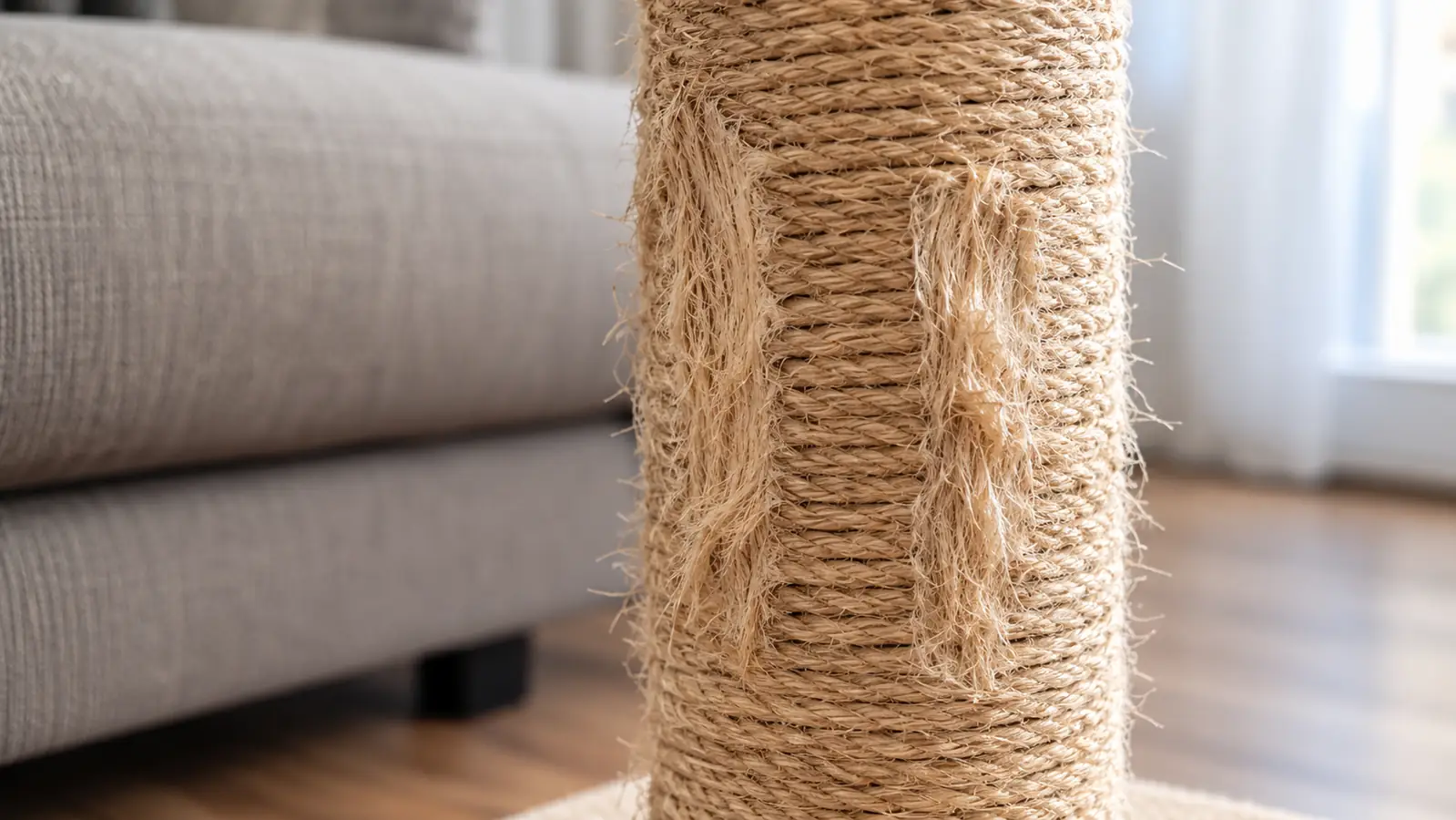
Mine has worn well. There are two long vertical patches down the front where Moose works, and the fiber there is flattened and lightly frayed, the way an old rope gets at a dock. The rest of the post is still tight. I have not found a loose strand long enough to worry about, and I have not seen the post underneath showing through anywhere. The listing makes a point about sisal that resists snagging, and after two years of daily use by a hard scratcher, I believe it.
One morning last January I sat down with my coffee and actually counted instead of guessing. Moose hit the post eleven times between seven and twenty to eight, sometimes a single long pull, sometimes three quick rakes in a row with a pause in between. Seven hundred mornings of that, more or less, is what the front of this thing has absorbed. The fiber has not gone bald and it has not started shedding into the carpet the way a cheap wrap does. What it has done is soften and roughen at the same time, which is precisely the surface a cat keeps coming back to.
When will it need replacing? I cannot tell you honestly, and anyone who gives you a date is guessing. At the rate the front patches have worn, I would expect a few more years before it is a concern, which would put the whole life of the piece somewhere near five. For something Moose attacks daily, that is a long run.
The care instructions say hand wash only, and I think that is worth knowing before you buy. This is not a piece you haul into the bathtub. I have never washed mine. I vacuum the base and the post with the brush attachment every couple of weeks and once a year I go over the sisal with a damp cloth and let it dry near the window. That is the whole maintenance routine, and it has been enough.
The One Thing I'd Change
The base. Not because it is unstable, it is the opposite of unstable, but because sixteen inches square is a great deal of floor. My sofa sits about four inches off the laminate and the base tucks under the front edge just enough that I have to think about it every time I vacuum. In a smaller living room I would find that genuinely annoying rather than mildly annoying.
One practical note if you plan to move it around. I shifted mine six inches toward the window last spring to make room for a lamp, and it left four shallow dents in the laminate that are still there this winter. That is not a fault of the post. It is thirteen and a half pounds doing what thirteen and a half pounds does on a soft floor. If your flooring shows marks the way mine does, put something under the base before you set it down, because you will not want to lift it twice.
I would also like a little more rigidity where the post meets the base. When Moose hits it from the side rather than straight on, there is a small amount of flex at that joint. Two years in, it has not loosened and it has not cracked, so I am not telling you it is failing. I am telling you I notice it, and I notice it more now than I did the first winter. If your cat is heavier than sixteen pounds, or is the sort who climbs the post rather than scratching it, you are asking more of that joint than I have.
That is my entire list of complaints. A wide base and a bit of flex. For a piece that has taken two years of hard use, that is a short list, and I have owned plenty of furniture I could not say that about.
The Long Haul: What Two Years Buys You
I have bought a great many cardboard scratchers over the years. My cats destroy them in about six weeks, and then there is a pile of corrugated confetti across the rug and I am ordering another one. I am not going to put a figure on what that adds up to, because prices move and my arithmetic before breakfast is not trustworthy. But the shape of the comparison is clear enough.
The cardboard ones had a way of ending up in the same spot every time: flat on the laminate beside the sofa, ragged at the corners, with a fan of shreds working its way under the coffee table. I would sweep it up, turn the thing over, get another couple of weeks out of the back side, and then start over with a fresh one. It was not the cost that wore me down so much as the chore of it, the constant small restocking of a thing that was always in the process of being destroyed. Two years of not thinking about that has been worth something on its own.
One post, bought once, still working two years later, against a new corrugated scratcher every month and a half. Even without doing the sums, the post is the cheaper way to keep a cat off a sofa, and it does not leave a paper trail through the living room.
Whether the current price of the SmartCat post feels fair to you is a judgment I cannot make from my kitchen. What I can tell you is what you get for it: thirteen and a half pounds of post, a base that stays put, two screws, two dowels, ten minutes of your morning, and then nothing else for a couple of years. If that sounds like a reasonable trade, it is.
What I Liked
- Thirteen and a half pounds on a sixteen-inch base. Moose has not tipped it once in two years.
- Two screws and two dowels. Ten minutes with a screwdriver, no helper required.
- Sisal still tight after two years of daily scratching, with no loose strands and no bald patches.
- Thirty-two inches gives a big cat a full standing stretch.
- Nothing to plug in, nothing to refill, no replacement parts to keep track of.
Where It Falls Short
- A sixteen by sixteen inch base eats floor space at the end of a sofa.
- Plain. It reads as a scratching post, not as furniture.
- A small amount of flex at the joint when a cat hits it from the side.
- Hand wash only per the maker, which in practice means vacuuming and spot cleaning.
- No perch, no bed, nothing soft. It is a post and only that, which leaves older cats cold.
Who This Is For
This is for the household with a cat who scratches hard and a sofa you would like to keep. If your cat is big, or likes to stand and stretch, or has already chosen a piece of your furniture, the SmartCat post gives them somewhere better to put that energy and it will not tip and scare them off it.
It is also for anyone who is tired of buying the same thing over and over. I know the difference now between a purchase and a purchase you repeat, and this has been the first kind.
And it suits an older cat owner, honestly. There is nothing to plug in, nothing to refill, no parts to keep track of. It goes together in ten minutes and then it simply stands there and does its job, which is more than I can say for a good deal of what I have bought for these cats over the years.
Who Should Skip It
Skip it if floor space is tight. Sixteen inches square at the end of a sofa is real estate, and in a small apartment you will feel it every time you walk past with a laundry basket.
Skip it if you were hoping for a perch or a bed built in. This is a scratching post and nothing else. Pepper wanted somewhere low and soft to sleep, and she got the donut bed in the bedroom instead. The post never entered that conversation.
And skip it if you need cat furniture that looks like something other than cat furniture. There are posts that hide inside a bookcase or pass as sculpture. This is not one of those. I would rather have the weight and the stability than the disguise, but that is a trade each household has to make for itself.
If the sofa arm has already become the scratching post, this is the fix
Two years in, mine has not tipped, has not shredded, and has not needed replacing.
Amazon Check Today's Price on Amazon →