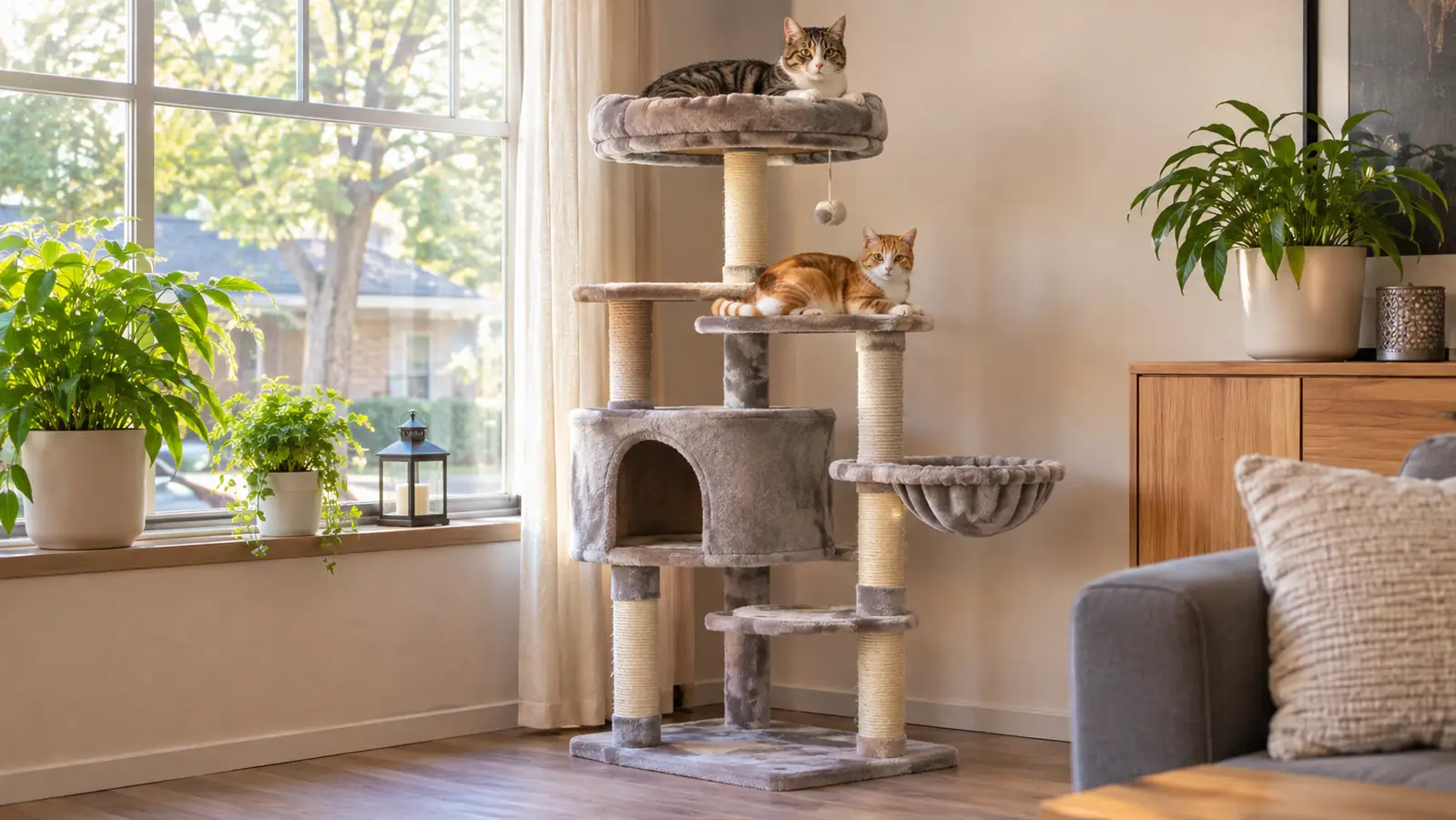
Moose is four years old, orange, and sixteen pounds, and he does not climb a cat tree so much as hit it at a run. The tower he destroyed was a bargain model I bought because it looked tall in the product photo. Every time he landed on the top perch it leaned about four inches off plumb, and by the end the whole thing swayed like a fence post in a windstorm. I gave it to a neighbor with a kitten. About fourteen months ago I replaced it with the Yaheetech 63in cat tree, and that one is still standing in the corner of my living room by the front window.
I am sixty-six and retired, and my late husband and I remodeled this 1970s ranch house one room at a time, so I have opinions about hardware, fabric, and whether a piece of furniture looks like it belongs in a grown-up living room. That is what this review is. Not a lab test. Fourteen months, two cats, one laminate floor, and a tower that had to survive a very large male cat with a lot of confidence.
The Quick Verdict
Built for a heavy cat: thirty-four pounds of particleboard on a 30.5 by 19 inch base, an anti-toppling kit I actually anchored, and five platforms. It is not hand-built furniture and the bolts want a second look at six months. Mine has not moved.
Amazon Check Today's Price →The tower that has not budged in fourteen months
Sixty-three inches tall, five platforms, a 21 by 15 inch foam-edged perch, a condo rated to 22 lb, and an anchor kit in the box. Current price and the full review count are on the listing.
Amazon Check Today's Price on Amazon →How I've Used It
The box came in at just over thirty-four pounds and I carried it in myself, one end at a time. Assembly took me about an hour with the Allen key that came in the box, working alone on the living room rug. I laid every part out on an old bath towel first and matched them against the illustrated page before I turned a single bolt, which is a habit from remodeling this house room by room. The parts are labeled and the manual is drawn rather than a wall of text, which matters at my age and matters more if you have never put one of these together. I did not need a second person for any step, and I never had to stop and hunt for a tool the box had left out. The only part I would not do alone again is tipping the finished tower upright, because at sixty-three inches it is awkward to stand up in a room with furniture in it. I walked it up against the back of the sofa and it came over fine, but move the coffee table first.
It sits in the corner by the front window, where the sun lands in the afternoon. The footprint is thirty and a half inches by nineteen, so it takes a real corner but not the whole corner. I can vacuum around it without moving it, and I can still reach the window to close the blinds. My sofa sits about a foot and a half away and nobody has to turn sideways to walk past it, which I could not say about the old tower.
Moose claimed the upper half within a day and has used it every day since. Pepper, who is nine and stiff in the hips, never goes above the lowest platform and the condo. That has been the pattern for fourteen months and I do not expect it to change. At about six months I went around the whole thing with the Allen key and snugged the bolts. A couple of them turned a quarter turn. None were loose enough to worry me, but I would put a reminder in your phone to do the same, because particleboard compresses a little under a heavy cat over time. I did it again at the one-year mark out of habit and found almost nothing to take up. That first check is the one that mattered.
What 34 Pounds of Particleboard Buys You
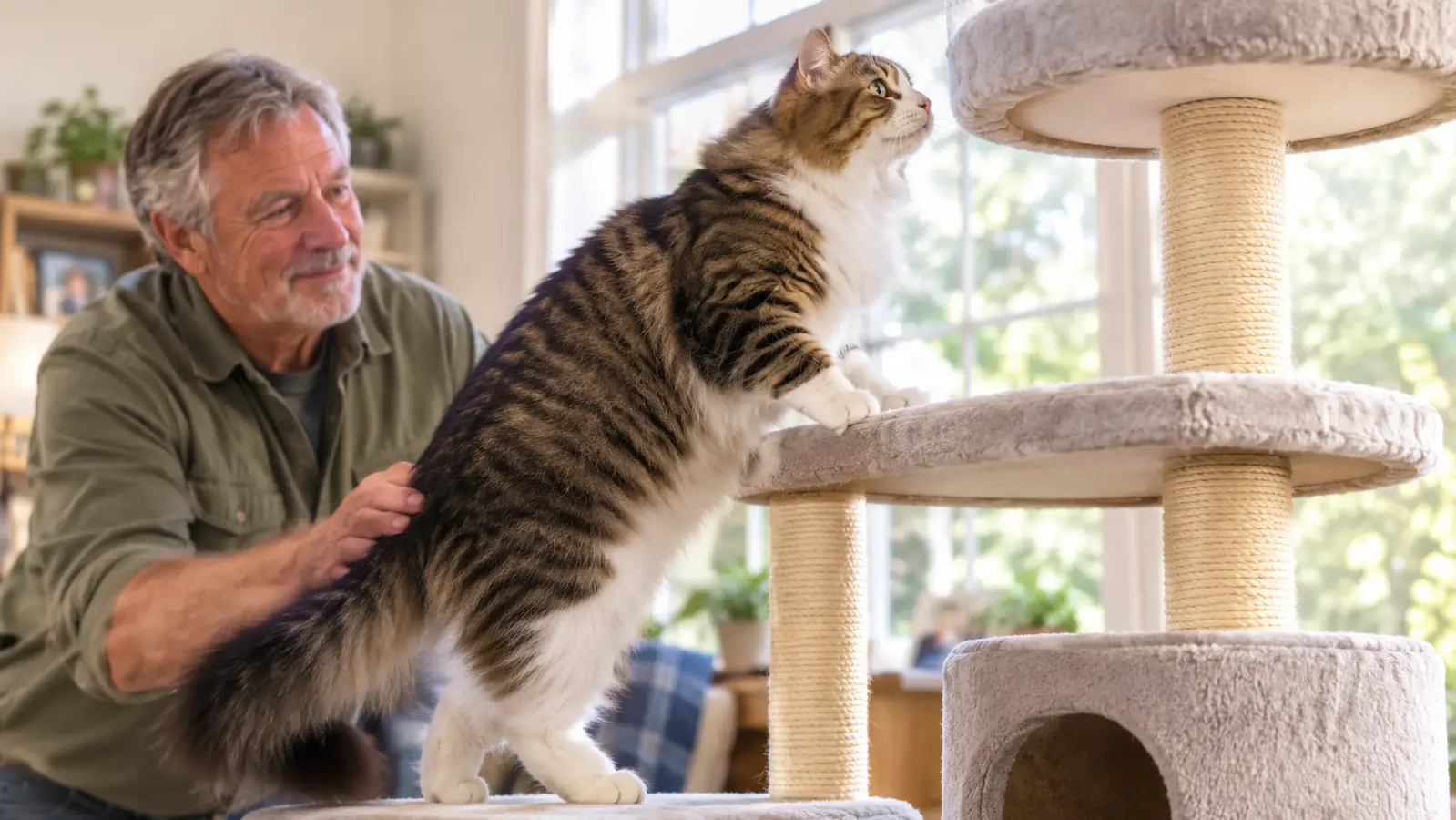
The Yaheetech is thirty-four pounds, and that sounds like a shipping detail until you have owned a light cat tree. Weight low down is what keeps a tower from walking across the floor when a sixteen pound cat lands on the top perch. This one is built from particleboard with plush covering and sisal rope wrapped around the posts, and it is floor mounted, which is the honest description of it. It does not hang on anything or lean on anything. It sits on the floor and it stays there. Before I bought it I looked at a lighter tower that weighed about half as much, and standing next to it in the store I could feel the difference in how the base sat on the floor.
The tradeoff is that particleboard is not oak. If it gets soaked it swells, and it does not come back from that. I have wiped mine down with a damp cloth and it has been fine, but I would not use a wet mop on the base and I would not let a cat urinate on it and leave it. Treat it like the flat-pack furniture it is and it will last years. Treat it like a porch swing and it will not. My panels arrived with no dents and no chipped corners, which is more than I can say for a bookshelf I ordered two winters ago.
I also want to be plain about what it is not. It is not a piece of hand-built furniture. The seams are visible if you get down on the floor and look for them, and the plush is a practical fabric, not something you would upholster a chair in. What you are buying is a tall, stable structure that a big cat can throw himself at without bringing it down. On that measure it has done exactly what I needed it to do, and I would buy it again tomorrow.
If you have ever assembled a bookshelf from a flat box, you already know the failure point on these towers is not the panels. It is the hardware. The bolts on this one are ordinary furniture bolts, no better and no worse than what you would get with a dresser, and they are the reason I keep the Allen key in the drawer under the lamp instead of throwing it away.
Six Levels, and Which Ones My Cats Actually Use
The tower has six levels and five platforms, a foam-edged perch measuring twenty-one by fifteen inches, a condo rated for up to twenty-two pounds, and a hammock rated up to eighteen. Those weight ratings are worth holding against your own cat. Moose is sixteen pounds, so he is inside the condo rating with room to spare, though he is too proud to use it. Pepper is eleven pounds and sleeps in the condo most afternoons, and she takes up maybe two thirds of the floor of it, so a bigger cat would fill it right up.
The foam-edged perch is the piece I did not expect to care about. Pepper's hips are stiff, and a hard platform is a platform she will not lie on. That padded edge gives her something soft to step onto before she settles. It is a small detail and it is the reason she uses the tree at all instead of just walking past it on her way to the window. The hammock, for what it is worth, gets ignored by both of mine. Hammocks are a young cat's toy and neither of mine is young. Yours may disagree.
The upper perches of this Yaheetech tower belong to Moose. He likes height and he likes the glass, and the top of a sixty-three inch tower puts him above the sill where he can watch the street and the neighbor's dog. If you have a cat that wants to be high, this is high. What I would tell you is to think about your own cat's age before you buy anything this tall. A young cat will use every level. An older cat may use two and ignore the rest, and that is not a fault in the tree, it is just the cat. If Pepper were my only cat I would have bought something waist high and saved the floor space.
The Base, the Anchor, and the Night Moose Nearly Won
The base is thirty and a half inches by nineteen, which is wide for a tower this shape, and it comes with an anti-toppling kit and a wall anchor. I used the anchor. I want to be clear about that, because I have read reviews from people who skipped it. You are putting sixty-three inches of particleboard in a room with a cat that runs. Anchor it to the wall. It took me ten minutes and one bracket, and it is the difference between a piece of furniture and a hazard. Mine went into a stud because that corner happens to line up with one. If it had not, I would have used the drywall hardware and been careful about it.
The night Moose nearly won was about four months in, a Tuesday in late October with the front window cracked open. He came off the windowsill at a full run, hit the second platform, and went straight up to the top perch in one motion. The tower rocked maybe an inch and stopped. The old one would have gone over, and I would have been writing a different article. That is the review in one sentence, honestly, and everything else here is detail around it. I have watched him do it a hundred times since and I still look up when I hear him land.
How It Looks in a Living Room
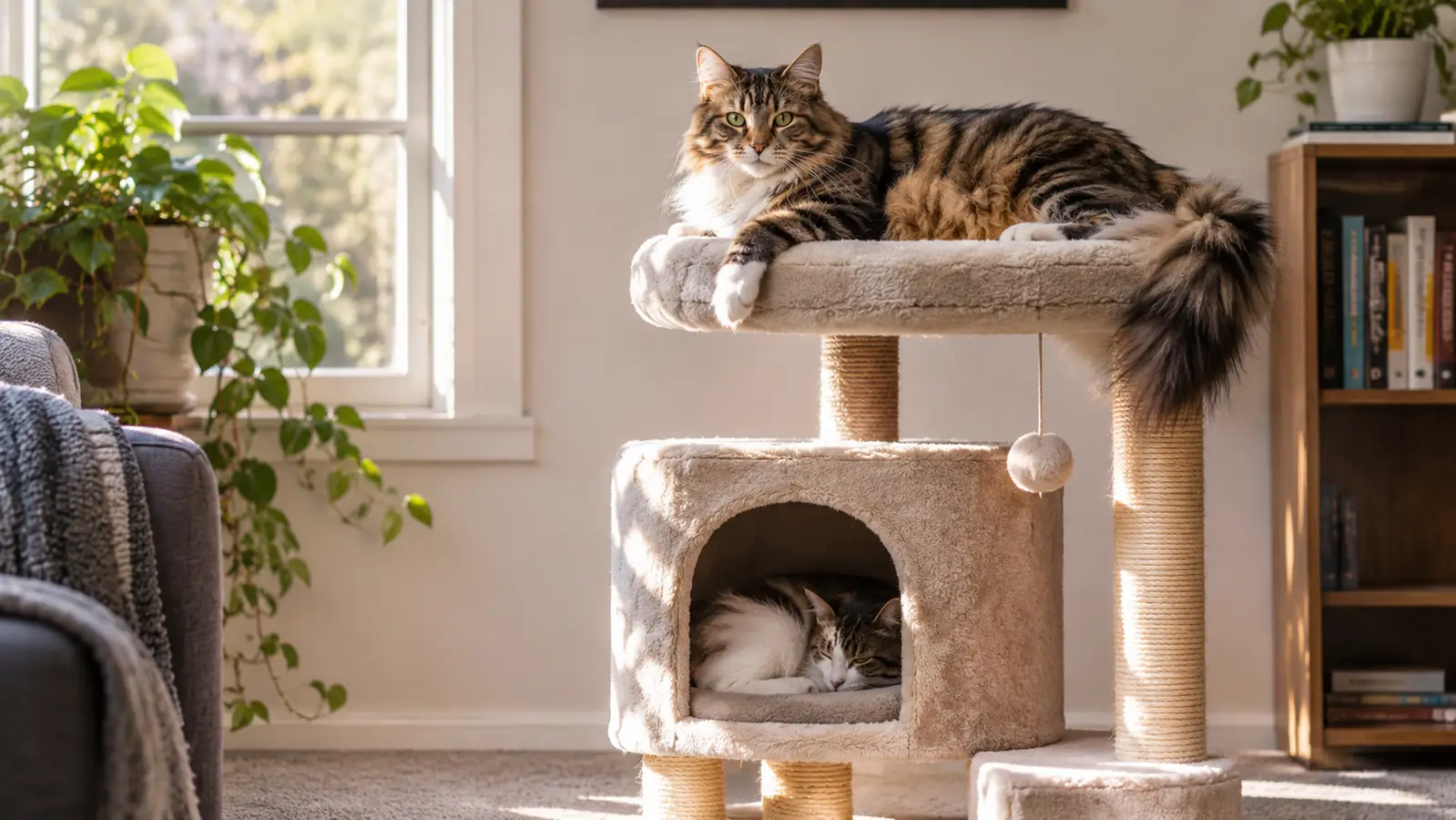
I have laminate floors and a big front window, and I did not want a cat tree that looked like gym equipment parked in the corner. This one reads as furniture from across the room. The plush is soft enough that I will sit on the floor next to it, and the proportions are tall and narrow rather than squat and wide, so it fits a corner without eating the room. My living room is not large and the tower has not made it feel smaller, which is the whole test as far as I am concerned.
What it does not do is hide cat hair, and no plush surface will. I keep a rubber brush near it and go over the platforms once a week, and I vacuum around the base when I do the floors. The sisal has held up well. Moose scratches hard and daily, and after fourteen months the rope is fuzzy but not shredded. When something finally gives on this tower, I expect it will be the wrapped posts, and that is normal for any sisal tower at this age. I have priced replacement rope and it is cheap enough that I will rewrap rather than replace the tree.
One more practical note. My grandchildren visit often, and a tall tower in a living room full of children is a climbing frame waiting to be climbed. The anchor matters more on those days, not less. I have never had a problem, but I check the bolts before they come over, and I keep the tower out of the main path between the front door and the kitchen so nobody has to dodge it. If you have small children and a big cat in the same house, pick the corner before you build the tower, not after.
What I Liked
- Thirty-four pounds on a 30.5 by 19 inch base, so it does not walk or tip when a big cat lands on the top perch
- Anti-toppling kit and wall anchor are in the box, and I used both
- Assembled alone in about an hour with the included Allen key, labeled parts and an illustrated manual
- Five platforms across six levels, including a 21 by 15 inch foam-edged perch and a condo rated to 22 lb
- Sisal posts still intact after fourteen months of hard daily scratching
Where It Falls Short
- Particleboard swells if it gets wet, so no wet mopping the base
- A few bolts needed a quarter turn at the six month mark
- At sixty-three inches tall, an older cat may only ever use the bottom two levels
- Plush holds cat hair and wants a weekly brush
- Seams are visible on close inspection at the base
The tower rocked maybe an inch and stopped. The old one would have gone over.
Who This Is For
This is for the household with a big, active cat who treats furniture as a challenge. If your cat is over twelve pounds, jumps hard, and has already wrecked something lighter, the weight and the wide base and the anchor kit are exactly the three things you are paying for. It is also for anyone who has to assemble it alone, because one person with an Allen key can do it in an hour. And it is for a home where the cat furniture has to live in a room you actually use, since it looks tidy enough in a corner that you will not resent it. Room for a condo sleeper and a high percher in the same tower is the other reason the Yaheetech works in a two cat house like mine, where the cats want completely different things from the same piece of furniture.
Who Should Skip It
Skip it if your cat is elderly and arthritic and has stopped jumping, because you will pay for five platforms and use one. Skip it if you are not willing to put a screw into the wall, because a sixty-three inch tower with a climber on it should be anchored and I would not recommend otherwise. Skip it if you want heirloom furniture, since this is flat-pack particleboard and it looks it up close. And skip it if you expect the plush to stay hair-free without any effort from you. None of that is a knock on the tree. It is just an honest list of who it does not suit.
If your cat is the reason furniture fails, start here
Fourteen months, one sixteen pound climber, one quarter turn on the bolts. That is the whole record, and the current price is on the listing.
Amazon See It on Amazon →