
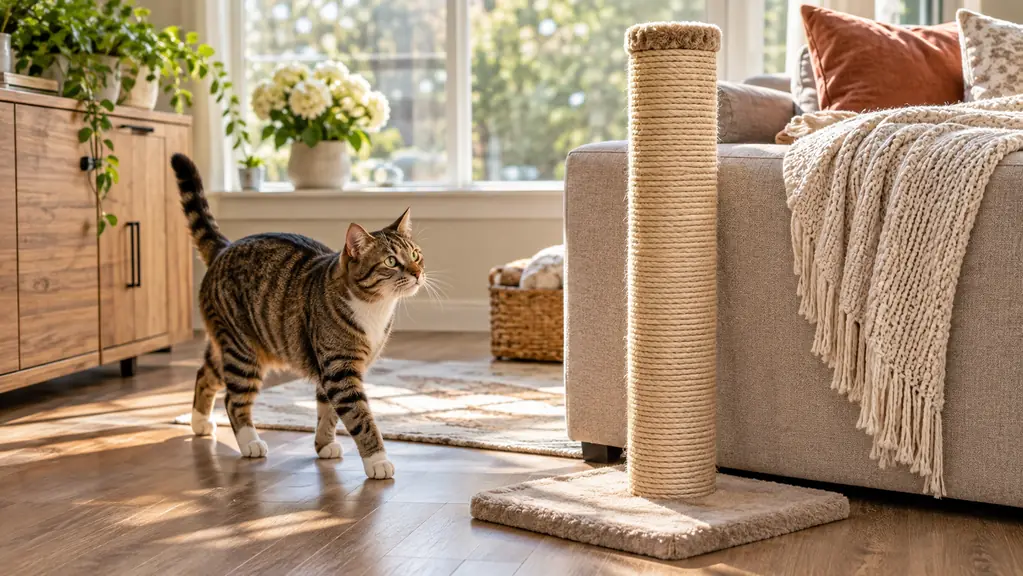
Moose is four years old, orange, sixteen pounds, and he scratches like the sofa owes him money. Two years ago he picked the front arm of my living room sofa and worked it over every single morning before I had my coffee. By the time I noticed, the fabric was frayed down to the backing in a patch the size of my hand.
I have had cats in this house for a long time, so I knew how the next part usually goes. You bring home a scratching post, the cat sniffs it once, and then goes right back to the sofa. I did not expect much when I set the SmartCat scratching post at the end of that same sofa. Two years later it is still standing in the same spot, the sofa arm has grown back a fuzz of new fabric, and Moose does not touch it anymore. What follows is what two years of daily use actually looks like, what held up, what did not, and which cats I would and would not buy it for.
The Quick Verdict
Two years of daily scratching from a sixteen pound cat and the sisal is worn in the middle but has not come apart. Heavy enough to stay put on a hard floor, tall enough for a big cat to pull against, and simple enough that two screws and two dowels were the whole assembly. The wide base eats floor space and it only does one job.
Amazon Check Today's Price →The post Moose could not knock over
32 inches tall on a 16 by 16 inch base, 13.5 pounds, wrapped in sisal fiber. Two screws and two dowels and it is standing at the end of the sofa.
Amazon Check Today's Price on Amazon →How I've Used It
The post went at the end of the sofa, on the laminate, roughly four feet from the big front window where the afternoon light lands. I put it there for one reason: that is where Moose was already scratching. If I had set it across the room by the bookcase because it looked tidier there, I would be writing a different article. Put it where the damage is happening. That single decision does more than any feature on the box.
The morning routine has not changed in two years. Moose gets up, walks to the post, hooks both front paws in, pulls hard enough that his back legs slide, then goes to his bowl. He does not use the sofa arm anymore and I did not have to train him out of it. I did not spray anything on the post, I did not use a deterrent, I did not do anything clever. I gave him something better to scratch and he took it.
Before the SmartCat I went through two cheap cardboard scratchers and a length of that double-sided sticky tape people sell for exactly this problem. The tape went on the sofa arm and lasted about a week before it was so furred over that it stopped being sticky, and Moose simply scratched three inches to the left of it. The first cardboard scratcher was a flat one on the floor and he ignored it entirely. The second one was a corrugated wedge that he used for about a month before it was a pile of confetti on the laminate, and I was sweeping that corner every other day. Years back, with a different cat, I tried a spray deterrent too. All that did was make the living room smell like a citrus grove and teach the cat to scratch when I was not looking. None of it addressed the actual complaint, which was that Moose wanted something firm to dig into and I had not given him one.
Pepper is nine, about eleven pounds, and a little stiff in the hips now. She does not climb and she does not do the big two-pawed pull that Moose does. What she does is walk up to the post, put her front paws on it as high as she can reach, and have a long stretch before wandering off. The 32 inch height is what makes that possible for her. She gets a real stretch out of it a few times a day, and then she goes back to a low perch.
The Sisal Is the Whole Point
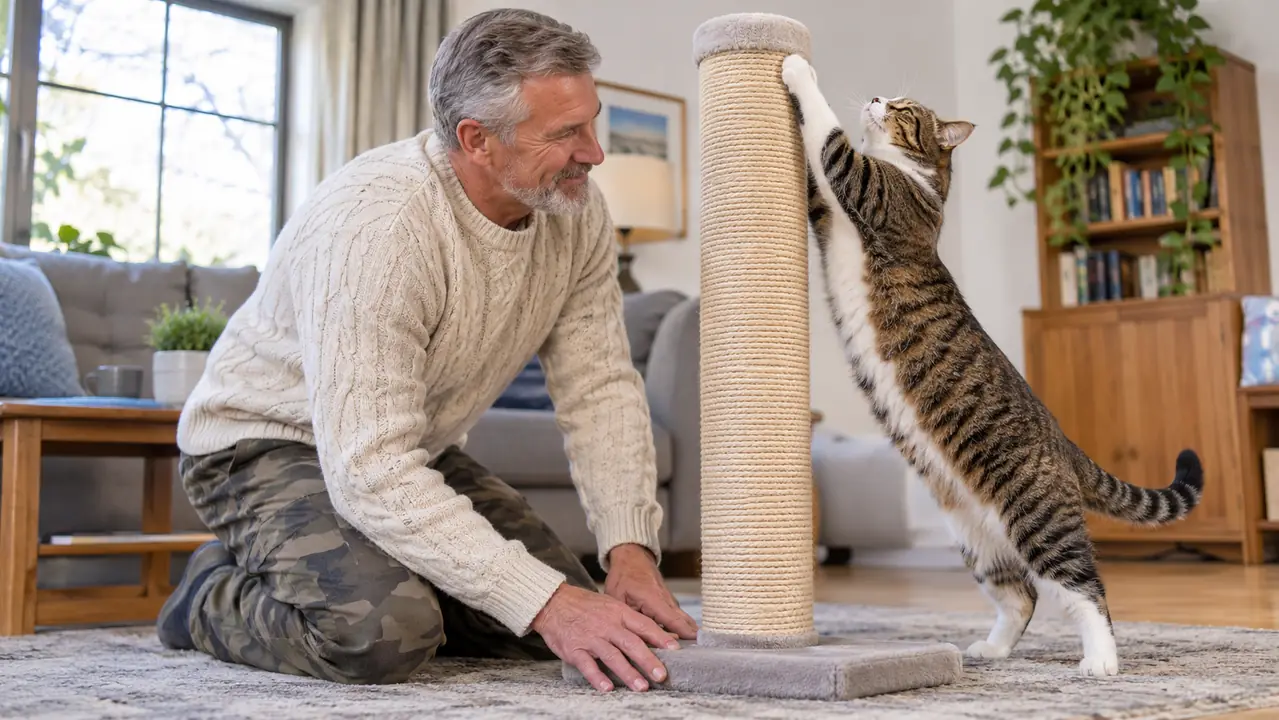
The SmartCat post is wrapped in sisal fiber, and that is the reason it works. Sisal has a coarse, stringy grip to it. A cat's claw catches in it and holds for a second, which is exactly the resistance they are looking for. Carpet is too soft. It gives under the claw, the cat does not get that satisfying grab, and in my experience they go looking for something firmer, like your sofa. Cardboard gives them the grab but it shreds, and you end up sweeping up a paper pile every week.
What surprised me is how much the post does not move. Moose is a big cat and he does not scratch politely. He goes at it with his whole body weight. The 13.5 pounds and the 16 by 16 inch base are what keep it flat on the floor while he pulls. On the laminate in my living room it has never slid, and I have never once caught it tipped up on an edge. That matters more than anything else, because a post that rocks gets abandoned.
Something else worth knowing is that this is one continuous column on a flat base, not a platform with a post bolted onto a shelf. When Moose hauls backward, the force goes straight down into that base instead of wrenching a joint where a post meets a perch. I think that is part of why the hardware has stayed tight. I have stood there and watched him dig in and pull with all sixteen pounds, and the column does not so much as lean.
Height matters more than people give it credit for. A cat scratching something flat on the floor cannot get the same pull as a cat stretched up on its back legs. The 32 inches gives a big cat room to reach nearly full extension, and that is where the real stretch happens, up through the shoulders and along the back. Watching Moose work it is a little like watching a person use a door frame to crack their back. Pepper, who cannot jump the way she used to, gets the same benefit at a slower pace.
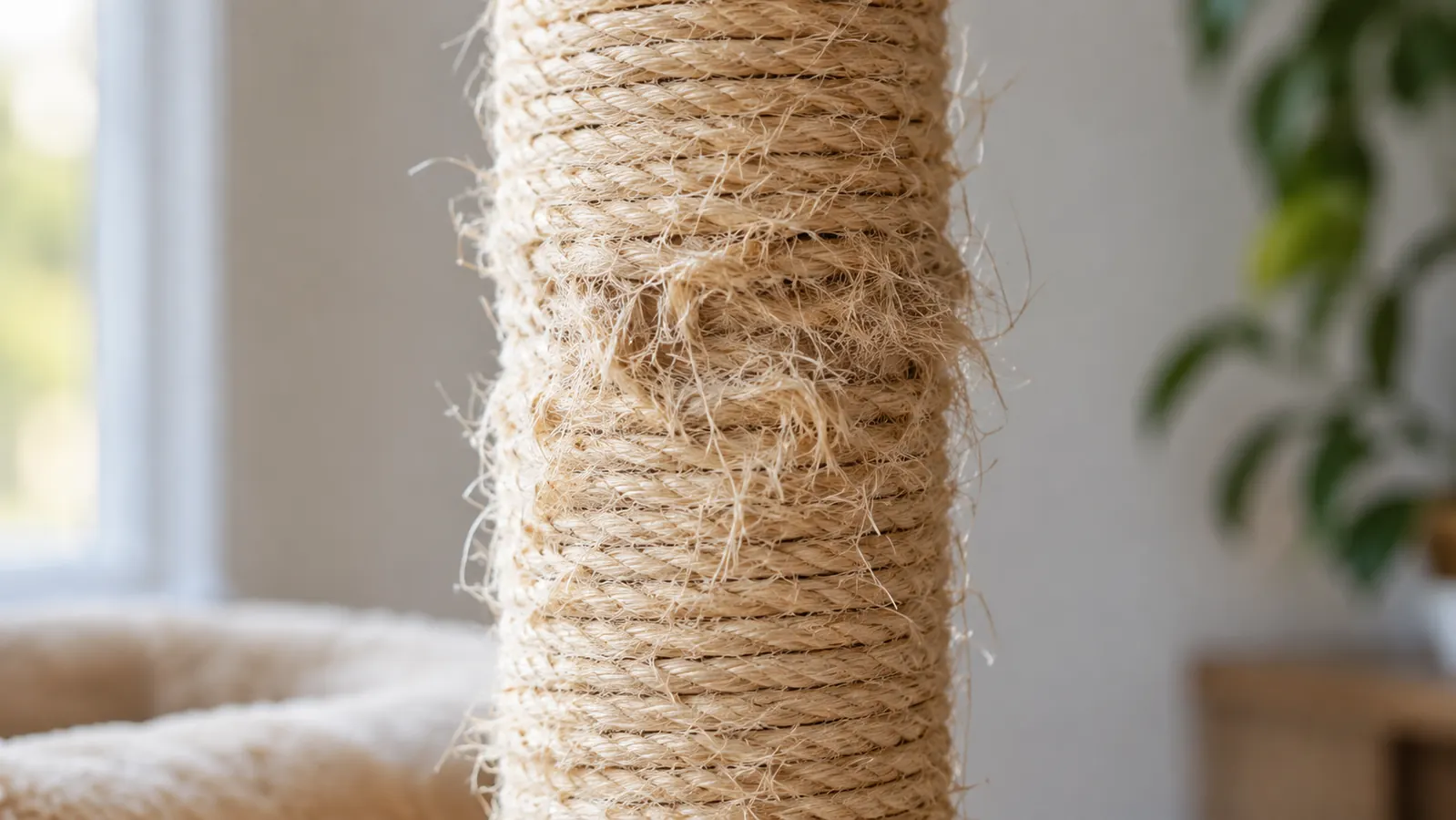
Two years of claws have worn the middle band of the sisal. That is where Moose's paws land, roughly two feet off the floor, and the fibers there are fuzzy and a little frayed. What has not happened is the wrapping letting go. It is still tight against the post underneath, there is no bare core showing anywhere, and nothing has come loose enough to dangle. I have seen cheaper posts unravel in a season.
Assembly, Weight and How It Sits in a Room
I put this together myself, on the living room floor, in about ten minutes. The SmartCat ships with two screws and two dowels, and that is the entire assembly. No Allen key puzzle, no bag of forty bolts, no page of diagrams I have to hold upside down. I am 66 and I have assembled a house full of furniture, and this was the easiest thing I have put together in years.
The two dowels seat into the base and hold the column upright, and the two screws go up through the bottom of the base to lock it down. I used a Phillips screwdriver out of my kitchen drawer, and that was the only tool involved. It honestly took me longer to get the tape off the box than to put the post together. The one thing I would tell you is to assemble it where it is going to live, or at least in the same room, because once it is together you are carrying 13.5 pounds of solid object across a floor and it is not going to be graceful.
The numbers matter if you are placing it. It stands 32 inches tall, the base is 16 by 16 inches, and the whole thing weighs 13.5 pounds. That weight is why it stays put, but it also means you are not sliding it around one-handed with a vacuum in the other. On my laminate it sits flat and does not walk. On the carpet in the bedrooms it would sink in a little and be harder to shift, which is fine, since I would not put it there anyway.
Measure the spot before you order, is my advice. Sixteen inches by sixteen inches sounds modest until you hold a tape measure against the wall and realize the sofa arm and the post together now want about two feet of clearance. Mine fits with a couple of inches to spare on the window side, and I checked that with the tape before I bought it, not after. If your sofa is jammed into a corner with no floor to spare, this is a decision you make before you click, not after the box arrives.
As for how it looks in the room, this is the least fussy cat furniture I own. It is a plain, square, sisal-wrapped column on a flat base. No castle. No dangling toys. No carpeted condo with a roof. I have a 1970s ranch house with a big front window and a sofa I actually like, and I do not mind looking at this. One practical note: the care instructions say hand wash only, which for a floor-standing post really means spot clean it now and then with a damp cloth. Do not put it in the tub.
Two Years In: What Wore and What Didn't
The sisal took the wear, the way it should. The middle band is fuzzy and lighter looking than the rest, and a few loose fibers end up on the floor when I vacuum. The wrapping underneath is still sound. I have not had to rewrap it, tape it, or turn it around.
The first real wear showed up at about eight months. That was when the middle band stopped looking new and started looking used, and there was a light dusting of sisal fibers on the laminate underneath the post every few days. It has not gotten much worse since. Two years on, the worn patch is maybe eighteen inches tall and it is the same patch, in the same place, because Moose scratches in the same place every morning. Cats are like that. They find the spot that works and they do not vary it.
The hardware is the part I did not expect to hold up so well. I have not touched those two screws since the day I put it together. Compare that with the tall cat tree in the corner, which I re-tightened at about six months because it had started to sway. The SmartCat post has never swayed. It is a short, heavy, simple object, and simple objects tend not to work themselves loose.
Maintenance has been close to nothing. I have wiped the whole thing down with a damp cloth maybe four times in two years, which is about as much attention as a scratching post deserves. I never rotated it and I never moved it to a different wall, because there was no reason to. It sits where it sat on the first morning and it works there.
Both cats still use it. Moose scratches it every morning, same as day one. Pepper still stretches on it a few times a day. The post outlasted my expectations by a wide margin, and the only thing I would call worn out is the surface, which is the part that is supposed to wear out.
The Parts I Don't Love
It does exactly one thing. Scratching. If your cat wants to be up high, or wants somewhere to sleep, this is not that, and you will still be shopping for a tree or a perch. In this house the post handles claws, the tall tree handles climbing, and the window perch handles the sun. Buying this thinking it will replace a tree will leave you disappointed.
The 16 by 16 inch base is a real square of floor you have to give up, and because it weighs 13.5 pounds you will grumble when you move it to vacuum underneath. I move mine about twice a month and I grumble both times. It is also a heavy, solid object, so if you are putting it in a small apartment, measure the spot first.
What I Liked
- Held up to two years of daily scratching from a sixteen pound cat, with the sisal worn but still intact
- Wide 16 by 16 inch base and 13.5 pounds of weight keep it flat, so it does not rock or slide on laminate
- 32 inches tall, enough for a stiff nine-year-old cat to get a full stretch
- Two screws and two dowels. Assembled on the living room floor in about ten minutes
- Plain enough to sit beside a sofa without looking like a cat castle
- Hardware has not loosened once in two years
Where It Falls Short
- Takes up a full 16 by 16 inch square of floor space
- Heavy and awkward to move when you vacuum
- The sisal sheds a few loose fibers, more so early on
- Does one job only. A cat who wants height and a perch still needs a tree
- Care instructions say hand wash only, so it is spot cleaning, not scrubbing
Two years, one sixteen pound cat, every morning before coffee, and the sisal is worn in the middle but has not come apart.
Who This Is For
This is for the person with a sofa, a chair, or a stair rail that is already taking damage. Put the post at the spot your cat has chosen and the odds are good that the damage stops there. It is also for bigger cats. Moose is sixteen pounds and heavy-handed, and this is the first post he has not been able to tip or shred. If you have a cat that scratches hard rather than often, the sisal and the weight are what you are paying for.
It also suits an older cat who still wants to stretch but no longer climbs. Pepper gets real use out of the 32 inch height without having to jump, which matters now that her hips are stiff. And it suits anyone who does not want a carpeted monument in the living room. It is quiet furniture.
Who Should Skip It
Skip it if your cat is a climber who wants to be at eye level, because this is not a tree and will never be one. Skip it if you are short on floor space, since the footprint is honest and you cannot trim it. Skip it if you want a piece that also serves as a bed or a lookout. And skip it if you are not willing to put it where the scratching is already happening, because a post parked in a spare room out of sight will not get used, no matter how well built it is.
If your sofa arm already looks the way mine did
Same post, same 32 inch sisal column, same two screws. Mine has been at the end of the sofa for two years and it is still the reason Moose leaves the furniture alone.
Amazon Check Today's Price on Amazon →