
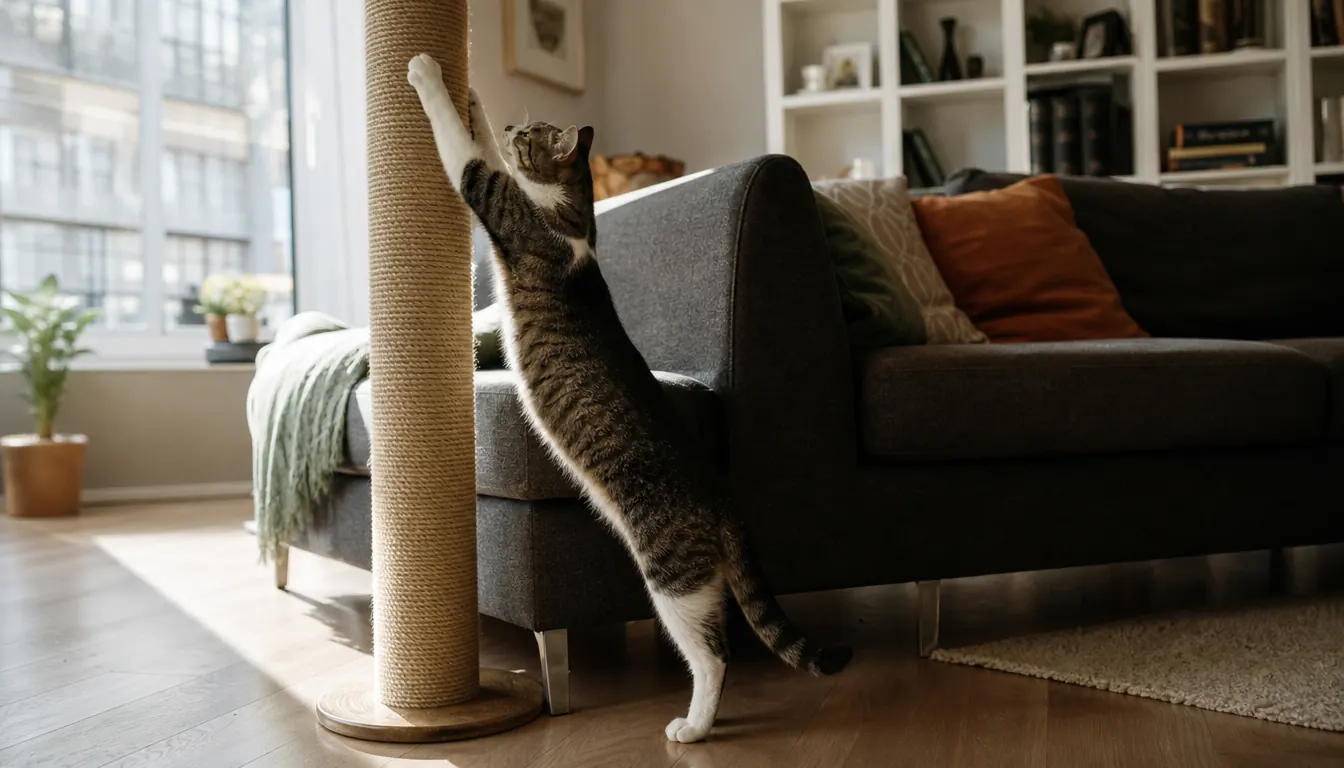
If you have about ten seconds, here is the short answer. A cardboard scratcher is easier to try and easier to move from room to room, but it will not hold up to a cat who scratches hard. The SmartCat scratching post is 32 inches of sisal on a 13.5-pound floor-mounted base, and mine has stood at the end of the living room sofa for two years without a wobble. Moose, my four-year-old orange tom, has gone at it every morning since the day I put it together. The sisal is worn. It is not torn. If your cat treats scratching like a job, the SmartCat post wins. If your cat treats it like a hobby, cardboard may be all you ever need.
Which one you should buy comes down to a single question: does your cat scratch like a hobby or like a job? Pepper, my nine-year-old tabby, scratches like a hobby. She is a little stiff in the hips these days and she likes low things, so a flat pad on the floor suits her, and she uses the tall post now and then for a stretch. Moose scratches like a job. He is sixteen pounds and he leans his whole weight into it, and anything light slides across my laminate. That is why this comparison is not really about which product is better. It is about which product matches the cat you actually have.
| SmartCat Scratching Post | Cardboard Scratcher | |
|---|---|---|
| Material | Sisal fiber wound tight on a floor-mounted tower | Corrugated cardboard, usually a flat pad or a shallow lounger |
| Height for a full stretch | 32 inches of vertical scratching surface | Flat on the floor, or a low angle at best |
| Staying put mid-scratch | 13.5 pounds on a 16 by 16 inch base, floor mounted | Light by design, slides on smooth floors |
| Mess around the house | Sheds little, loose strands pick off by hand | Drops cardboard flakes on the floor daily |
| How long it lasts | Two years of daily use, worn but intact | Weeks to a few months with a hard scratcher |
| Cleaning | Vacuum the base, hand wash only | Cannot really be cleaned once it is damp or soiled |
| Getting it set up | Two screws and two dowels | None at all, out of the bag |
| Floor space | 16 by 16 inches that stay occupied | Slides under a chair or behind a door |
| Texture some cats prefer | Firm sisal with little give | Soft bite that a hard scratcher can tear into |
| Trying it without commitment | A purchase before you know your cat will use it | Easy to test and easy to move to another room |
| When it is finished | A whole tower to deal with | Goes out with the recycling |
A word on how I read this table. I scored every row for my house, which means a sixteen-pound cat, slick laminate floors, and a sofa he had already claimed as his own. Your house is not my house. If you have a seven-pound cat who scratches politely twice a day, several of those losses on the cardboard side shrink, and the ease of trying one starts to look far more attractive. Read the rows, then read your cat.
Where SmartCat Wins
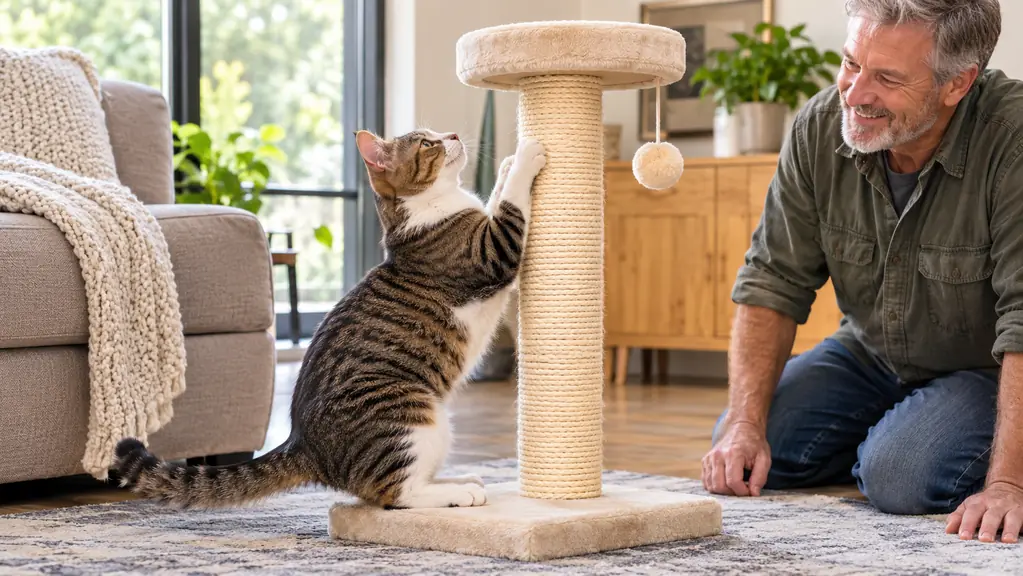
Start with height, because height is the whole point of a post. A cat scratching flat on the floor works its front claws and nothing else. A 32-inch post lets a cat stand up, reach the top of the stretch, and pull down through the whole spine. Moose does this every morning and it is the closest thing that animal does to a workout. Pepper, who will not climb anything, still walks over and pulls herself up to about shoulder height before she steps back down. That reach is the reason a tall post protects furniture better than a floor pad. It gives the cat somewhere to put the stretch she already wants to take.
Then there is the base. Sixteen inches by sixteen inches, floor mounted, and 13.5 pounds before the cat touches it. My laminate is slick and that post has never once skated. The cardboard scratchers I have owned were light on purpose, so a cat could drag them around the room, and drag them Moose did. Halfway through a hard scratch the pad would slide out from under him and he would finish the job on the sofa arm. A post that stays put gets used. A pad that runs away gets abandoned, and the furniture pays for it.
Assembly is the third thing, and it is almost funny how little there is to it. Two screws and two dowels. I had it standing by the sofa in about ten minutes with a screwdriver, and I am sixty-six years old and doing it alone in a house where I have remodeled most of the rooms myself. It also sits in my living room without looking like cat furniture. It reads as a plain piece of furniture standing at the end of the sofa, which matters in a house where the front window is the main view and everything is visible from the kitchen.
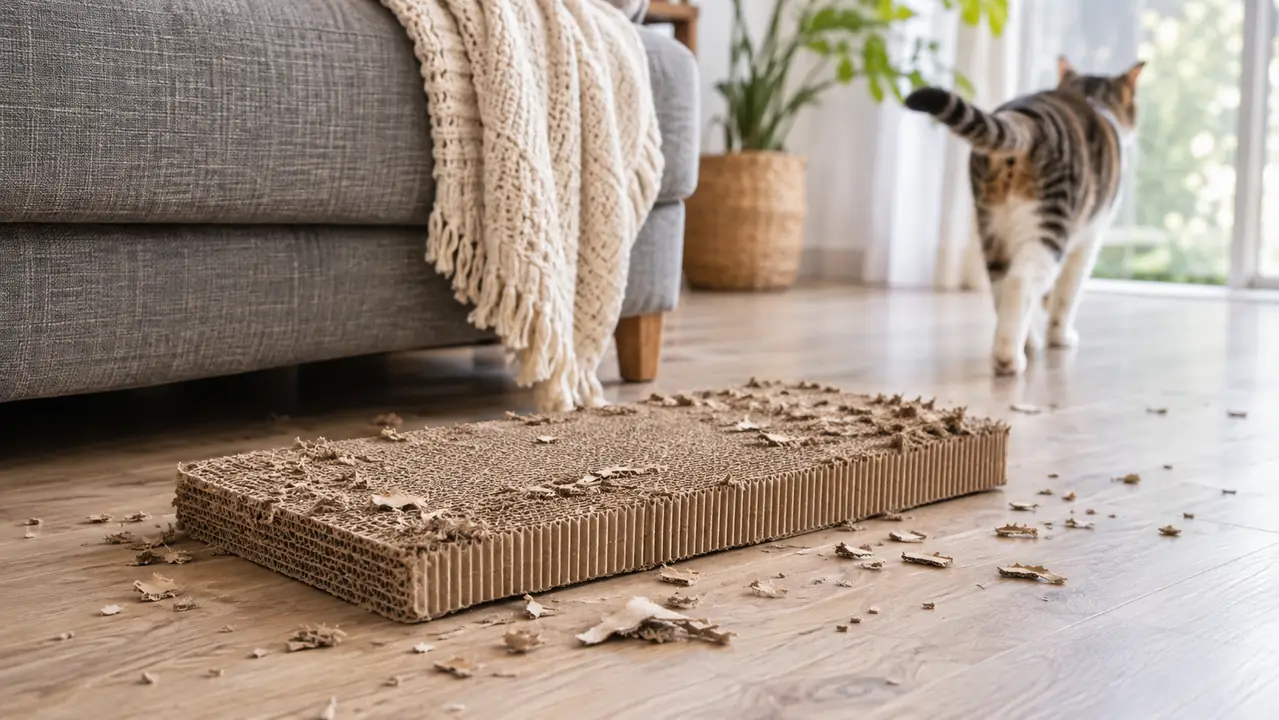
The sisal is the quiet win. It is wound tight enough that claws dig in and let go cleanly, with very little snagging and no shredding. Cardboard does the opposite. It gives a cat a satisfying bite and then it sheds, and you find brown flakes in the rug for months afterward. I vacuum around the post once a week and pick off the odd loose strand with my fingers. That is the entire maintenance routine. The listing says hand wash only, and I will be honest, I have never washed it. A vacuum and a lint roller have handled two years of daily use.
Where the Cardboard Scratcher Wins
I am not going to pretend cardboard has nothing going for it. It is the easiest thing in the world to try. You bring it home, you set it on the floor, and in three days you know whether your cat is interested. Nobody has to assemble anything or find sixteen inches of clear floor space in a room that is already full. If your cat sniffs it and walks away, you have lost an afternoon and a little pride. If you are buying for a cat you do not know well, or you are not even sure scratching is the problem, cardboard is the sane first move.
Cardboard also has a texture that some cats genuinely prefer. It has a soft bite, so a hard scratcher can dig in deep and tear off a strip, and plenty of cats find that more satisfying than sisal. Sisal is firm. It holds up, which is exactly why it does not give the same way. If you have already tried a firm post and your cat ignored it, that is real information about your cat. Some cats want the shred. Buying a second firm post will not change their minds, and you will have paid twice to learn the same thing.
Cardboard is also easier to live with in a small house. A flat pad slides under a chair, behind a door, or into the gap between the sofa and the wall. My post takes sixteen by sixteen inches of living room floor and it is staying there until one of us moves out. When a cardboard scratcher is finished you put it out with the recycling and that is the end of it. When a 13.5-pound tower is finished you have to decide what to do with a 13.5-pound tower. Two years in, I am nowhere near that decision, but I have thought about it.
What Two Years Did to the Sisal
Here is the honest accounting of wear. The post does not look new. There is a worn patch about a third of the way up where Moose starts his scratch, and the strands there have flattened into each other. The rest of the tower is intact. Nothing has come unwound, no section has gone soft, and it still stands dead straight against the sofa. At the two-year mark I checked the two screws at the base and neither had budged. That is a fair report on a piece of furniture that a sixteen-pound animal attacks every single morning.
Compare that to what a cardboard pad looks like after two months with the same cat. Cardboard does not really wear. It disappears. You get a soft center, then a hole, then a pile of flakes, and then you are buying another one. Over two years that is a stack of replacements and a lot of time with the vacuum. The SmartCat post was one purchase and a weekly pass with the vacuum, and I would rather do the vacuuming than the shopping.
The Annoyances
Nothing is perfect and I keep a short list. The post is heavy and it does not move, so when I want to vacuum under it I lean it over and hold it against my hip. The sisal cannot be washed properly. The listing says hand wash only, and if a cat ever sprayed it or got sick on it, I am not confident I could get it clean again. I have not had that problem, but I have thought about it. The base is also wide enough to catch dust along its edges, so the vacuum and I are well acquainted.
The worn patch bothers me more than it should. It is cosmetic, it does not affect how the post works, and Moose does not care in the slightest. But I noticed it at about eighteen months and I notice it every time I walk past. If a scratching post that looks a little used is going to annoy you, know that going in. The trade is a surface that holds up. A cardboard pad looks fresh for six weeks and then it looks like something came apart in your living room.
If Your Cat Ignores Both
Placement matters more than either product, and that is the part people skip. Put the scratcher where your cat already scratches, not where you would like it to go. In my house that meant the end of the sofa, because that is the exact spot Moose had picked. Move a post into a back bedroom where nobody sits and it will sit unused, and you will blame the post. Same with a cardboard pad. Put it where the family walks past and it gets used. Tuck it behind a bookshelf for tidiness and it does not.
Two years of a sixteen-pound cat scratching every morning, and the sisal is worn, not shredded. That is the entire argument.
The Post That Was Still Standing After Two Years
Sisal fiber, 32 inches tall, a 13.5-pound floor-mounted base, and two screws to put it together. Mine has taken two years of daily scratching from a sixteen-pound cat and it has not moved.
Amazon Check Today's Price on Amazon →Who Should Buy Which
Buy the SmartCat post if your cat is large, if your cat leans into a scratch, if your floors are slick, or if you have already replaced a cardboard scratcher more than twice in a year. Buy a cardboard scratcher if your cat is small and gentle, if you are not sure scratching is even the issue, if you rent and do not want to move a heavy thing again, or if you have a cat who has already refused a firm sisal post. Those are honest splits. Neither one is wrong for the wrong house.
If I were starting over with a cat I did not know, I would buy cardboard first and a post second. It is the low-commitment way to learn what your cat likes, and that lesson is worth more than getting the guess right on the first try. Once you know your cat is a hard scratcher, the SmartCat post is the one that stays. That is how it went in this house, two years ago, and the sofa has the evidence.
Match the Scratcher to the Cat You Actually Have
If your cat leans into a scratch the way mine does, you want the one that stays put. Look at the size and the base on the current listing and compare it to the space you have.
Amazon See the SmartCat Post on Amazon →