
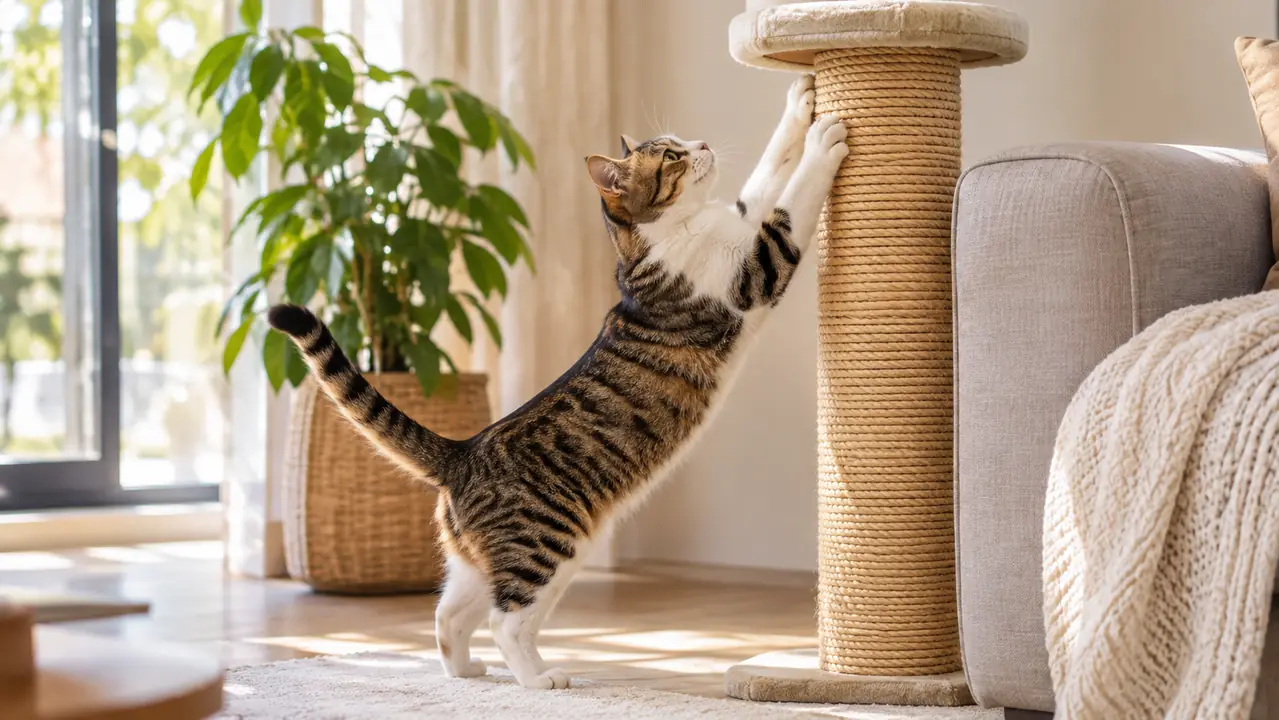
Moose started on the arm of the living room sofa about two years ago. Four in the morning, claws out, that ripping sound that gets you out of bed faster than any alarm. I tried the spray bottle. I tried yelling, which I am not proud of. I tried a cardboard scratcher that lasted about eleven days before it looked like confetti. What finally worked was a plain sisal post, the SmartCat scratching post, 32 inches tall, set at the end of the sofa where he was already scratching. He has not touched that arm since. Not once.
Here is the thing I wish someone had told me earlier. A cat does not scratch to ruin your furniture. She scratches to shed the dull outer layer of her claws, to stretch the whole length of her back, and to leave a mark that says this is mine. You are not training that out of her, and you should not try. You are giving it a better place to happen. Every step below is really about that one idea, and the SmartCat post is the piece of furniture that made it possible in my house.
Give the scratching a better address than your sofa arm
The SmartCat scratching post is 32 inches of tight sisal on a 16 by 16 inch floor-mounted base, 13.5 pounds so it stays put, and it assembles with two screws and two dowels. Roughly 34,000 ratings at 4.7 stars, for whatever that is worth to you.
Amazon Check Today's Price on Amazon →Step 1: Put the post where the damage already is
Most people buy a scratching post and tuck it in the basement or the back bedroom, then wonder why the cat ignores it. Cats scratch in places that matter to them. Usually that means near where they sleep, near a doorway they patrol, or right beside the couch you sit on every evening. Those spots are not random. They are the cat's main intersections, and a post in a spare room is not on any of them.
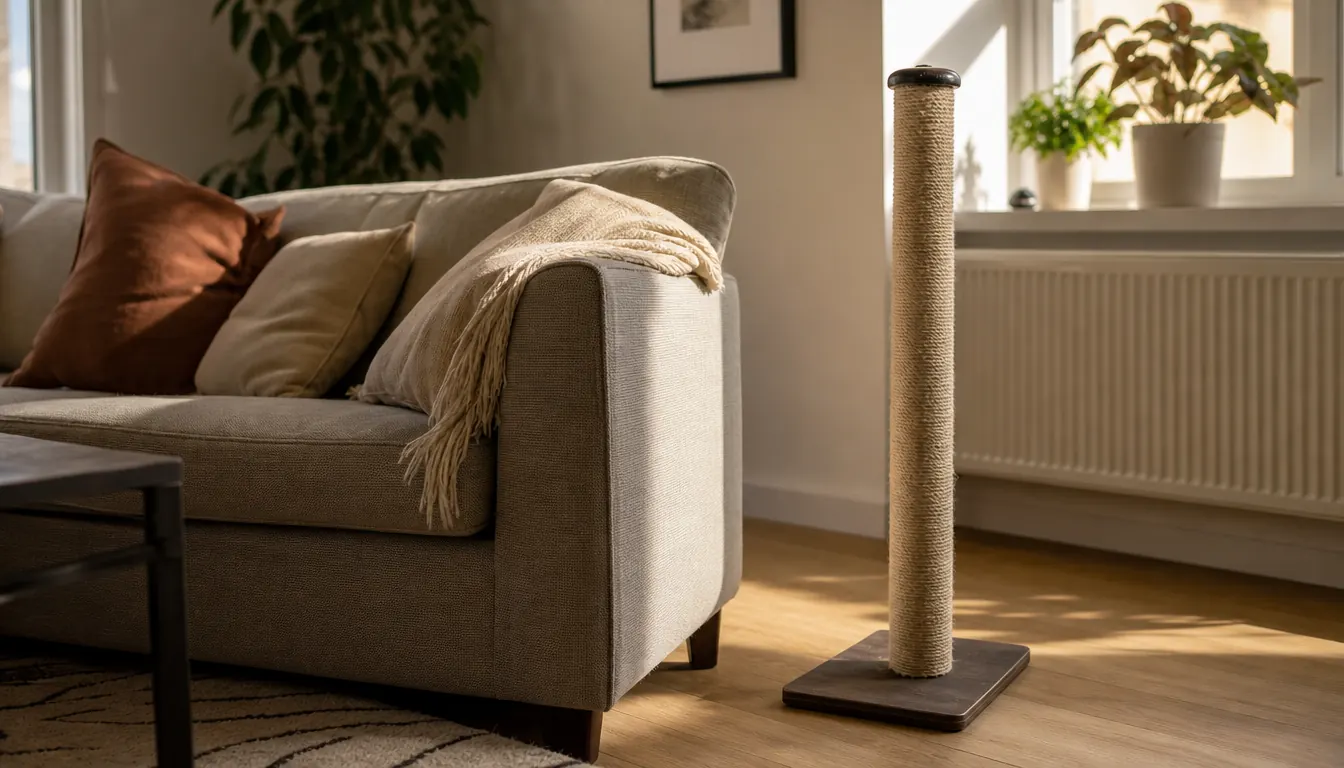
In my house the answer was embarrassingly simple. The post went at the end of the sofa, in the living room, in front of the sunny window where both cats already spend their afternoons. It is not decorative there. It is exactly where the problem was. I set it down, and Moose walked over and scratched it before I had the box broken down. That is what two years of spray bottles could not do.
If your cat ignores a new post, do not buy a different one yet. Move the one you have two or three feet and give it another week. Kittens and older cats both tend to scratch right after they wake up, so a post within a few steps of a favorite sleeping spot gets used far more than a prettier one in a hallway. Placement beats product every single time.
Before I bought anything, I walked the living room with a tape measure and wrote down where the damage was: the front left sofa arm, the corner of the hall carpet, and the side of the recliner. Three spots, all within about eight feet of each other. That told me the cat was not scratching at random. He was working a route. The first post I bought, a short one, went into the bedroom because that is where the ripping sound had woken me up. Wrong call. He used it twice in a week and went straight back to the sofa arm. The bedroom was not on his route. The sofa arm was.
Step 2: Get a post tall enough and heavy enough to survive the cat
Moose is sixteen pounds. When he stretches out on a post, he goes the full length of himself, front paws as high as he can reach. A short post forces a cat to scratch in two cramped rounds, and it wobbles while they do it, which is exactly the feeling they are trying to avoid. That is why flimsy posts fail. The cat is not bored with it. The cat does not trust it.
The SmartCat post is 32 inches tall with a 16 by 16 inch base and weighs 13.5 pounds. Moose can go all the way up without the thing tipping toward him. It is floor mounted, so there is nothing to mount to a wall and no hardware to find a stud for. Assembly took me about five minutes with a screwdriver, two screws, two dowels, done before my coffee went cold.
The scratching surface is tightly woven sisal fiber rather than carpet or corrugated cardboard. That matters more than it sounds. Loose carpet catches claws and gets shredded in sheets. Cardboard is satisfying for the cat and gone in a fortnight. This sisal has held up to a hard scratcher every morning for two years, and while it is visibly worn down the middle, it has not come apart.
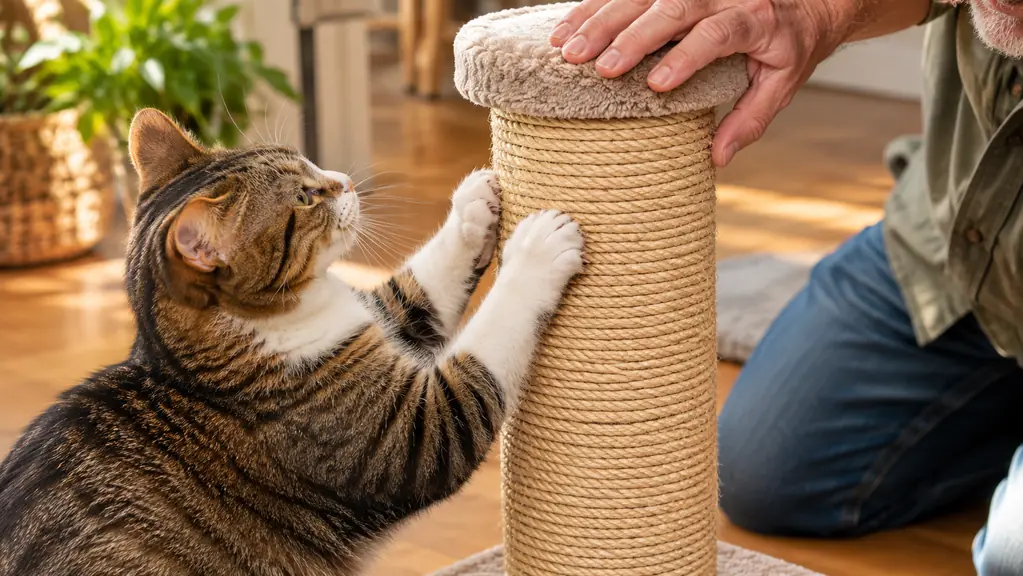
The test I use now is simple: put a hand on top of the post and push it sideways the way a cat leans into a stretch. If the base lifts off the floor, the post is too light for a big cat. Moose knocked over a cheap tree in the corner two years ago, and that was the last time I bought cat furniture by how it looked in a photograph. The 16 inch square base on this post does not budge on my laminate. I set it down, leaned on it, and it stayed flat.
Height matters as much as weight. Measure your cat from nose to the base of the tail and add a few inches. Moose runs about two feet stretched out, so 32 inches lets his front paws get near the top and pull down through the whole length of his back. A 16 inch post would put his paws at his own shoulder height, which is a cramped and cranky way to scratch.
Step 3: Redirect in the act, and make it worth the cat's while
When you catch the cat on the couch, do not swat, spray, or shout. All that teaches is that you are unpredictable when you come around the corner, and the scratching just moves to when you are not home. Instead, pick the cat up, calmly, and set her down on the post. Then drag your own fingernails down the sisal a few times so she hears the sound and sees the motion. Nine times out of ten she will finish the job herself.
Then praise. A calm good girl and a scratch behind the ear, or a small treat right on the top platform. It feels ridiculous the first week. It also works, because you are stacking a pleasant outcome on top of a behavior the cat already wants to do. My Pepper is nine and stiff in the hips, and even she uses the post now and then for a stretch, which is more than I expected.
What made it stick was timing. Cats scratch most reliably right after they wake up and right after they eat. So I stopped waiting to catch him in the act and started walking him to the post first thing. Alarm goes off, cats get up, I walk over and drag my nails down the sisal, and he follows. Six weeks of that and he was heading there before I got out of the hallway. It is not obedience. It is a habit with a reward at the end of it, and a habit beats a correction every time.
Pepper needed a different approach. At nine and stiff in the hips, she does not do a full stretch. She puts her front paws up maybe a foot and works her claws, then walks away. That is fine by me. She is using the post instead of the rug, and I am not going to fix what is not broken.
Step 4: Protect the couch while the habit resets
A cat that has scratched the same arm for a year has a groove worn into her routine. Even with a good post two feet away, she may go back out of habit for a few weeks. So make the old spot less rewarding in the meantime. A folded throw over the arm, the kind with a slightly slick weave, takes the satisfaction out of it. Double-sided tape on the arm works too and cats hate the feel of it.
What you are doing is temporary and you should treat it that way. The goal is a few weeks of the couch being dull while the post becomes the easy, pleasant option. Once the post is the habit, take the throw off. Do not leave the couch wrapped in plastic like a 1970s parlor. A house should still look like a house, and a cat that only has forbidden surfaces will find one you did not think of.
Step 5: Keep the post in service
A scratching post is a working piece of furniture, not a decoration you install and forget. Once a week I run the vacuum wand over the sisal to pull out the loose fibers, and I check the two screws at the base. I have never had one work loose on this post, unlike the cat tree I had to re-tighten at the six-month mark. The manufacturer lists the covering as hand wash only, so I spot clean with a damp cloth rather than dragging it out to the hose.
Sometime around the eighteen-month mark I turned the post a quarter turn so the worn patch faced the wall. Fresh sisal came around to the front and Moose treated it like a new piece of furniture. Expect to replace the post eventually. Tight weave or not, claws win in the end. Two years of daily use from one 32-inch post is a fair run, and I will buy the same one again when this one gives out.
The one thing I would change is the wear. Moose works the same spot every morning, right about the height of his shoulders, and after two years there is a shallow dent in the sisal there. That is normal and it does not mean the post is failing. Sisal is a plant fiber wound tight, and it compresses. As long as the fibers are not hanging off in ropes and the post still stands solid when you push it, keep using it. The day it starts shedding in clumps is the day to order another one.
What Else Helps
Trim the front claws every two to three weeks. A sharp claw does more damage in one pass, and a blunt one gives you margin while a new habit sets. I do it on a towel on the kitchen counter with the grandkids holding the treat bag, and it takes three minutes for both cats. You should also give the cat a legal place to climb, not just a place to scratch, because a cat that is bored in three dimensions will find something to do. The tall tree in my living room corner handles that job, and the post handles the claws. Two different jobs, and neither one replaces the other.
A couple of flat cardboard scratchers in other rooms are a reasonable supplement, and I keep one in the bedroom. Just do not make cardboard the main event, because you will be buying it every month. And please, do not declaw. It is not a manicure, it is surgery on the ends of the toes, and every veterinarian I have asked about it in forty years has said the same thing.
Moose is sixteen pounds and he scratches that post every single morning. Two years in, the sisal is worn down the middle and it still has not come apart. The sofa arm behind it looks brand new.
Two years in, mine is still standing at the end of the sofa
One sisal post, 32 inches tall, 13.5 pounds, floor mounted, assembled in about five minutes. It is the only thing in this house that ever convinced Moose to leave the furniture alone.
Amazon Check Today's Price on Amazon →