Two winters ago I stood in my own living room and watched a cat tree go over sideways. Moose was on the top platform, he shifted his weight the way a big cat does, and the whole tower leaned into the wall and kept going. He landed on his feet, insulted but fine. The tree did not survive the afternoon. I had bought it because it was tall and because the picture on the listing was pretty. I had not asked a single question about the base, the hardware, or what the platforms were actually made of.
If you share a house with a heavy climber, that order of thinking is backwards. Sixteen pounds going up and coming down at speed puts loads on a piece of furniture that an eleven pound cat never will. You have to shop for structure first and looks second, the same way you would shop for a shelf that holds your good dishes. I learned it the hard way. What follows is the checklist I use now, and it is the reason a Yaheetech 63in tower has stood in my front window corner for the last fourteen months without a wobble.
The tower that outlasted my sixteen pound climber
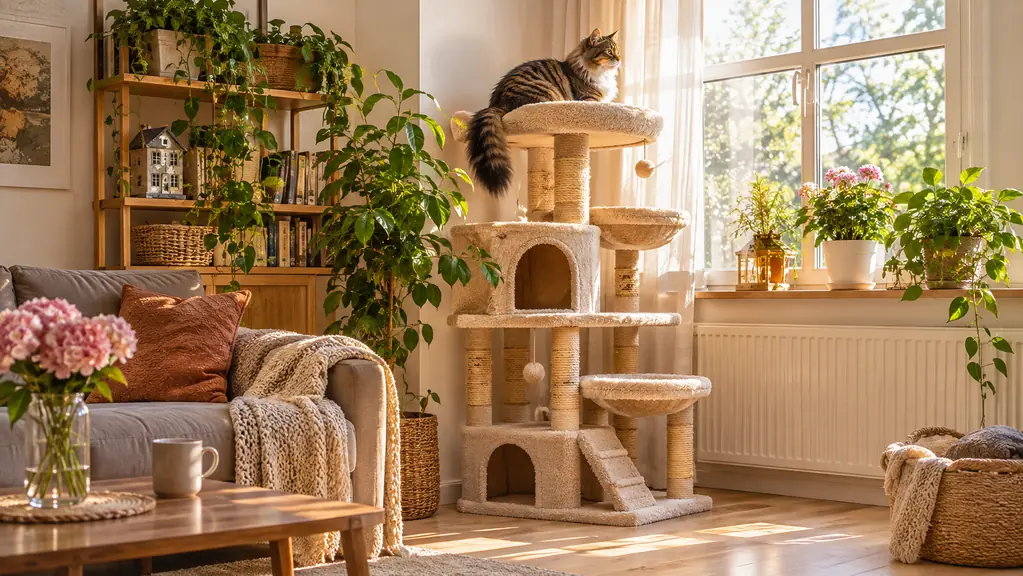
Six levels and five platforms on a base that measures 30.5 by 19 inches. A condo rated to 22 pounds, a hammock rated to 18, and a wall anchor in the box.
Amazon Check Today's Price on Amazon →Step 1: Weigh the Cat, Not the Advertising
Cat trees are sold on height. Height is the least useful number on the page. What you actually need to know is how much cat the thing is built to hold, and where that cat is going to want to be at four in the afternoon.
A cat does not land at its body weight. When Moose comes off a platform he is not stepping down, he is pushing off, and all of that force goes through four bolts into a piece of board. Do that twenty times a day and the furniture starts to tell you the truth about itself. So get a real number first. Weigh the cat on the kitchen scale, the way you would weigh a suitcase before a flight, and write it down where you can see it while you shop.
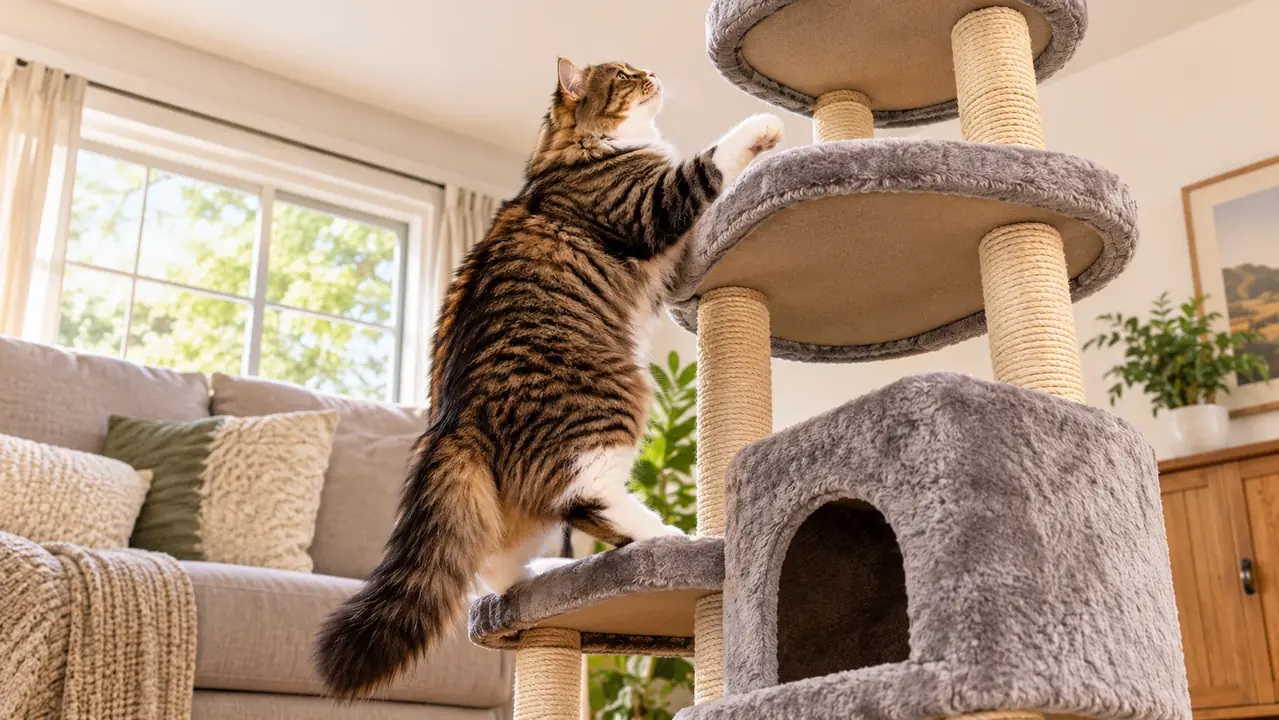
Pepper is nine and about eleven pounds, and she is a little stiff in the hips now. She uses the lowest platform and the condo and she does not go higher than that, so her weight is not the problem. Moose is four and sixteen pounds and he wants the top of everything. A tree has to serve both of them without asking either one to compromise on the furniture's behalf. That means a low, easy first step for her and a properly rated perch up high for him.
Then read the individual ratings rather than the headline number. The Yaheetech lists five platforms, a 21 by 15 inch foam edged perch, a condo rated to 22 pounds, and a hammock rated to 18. Those are the numbers to hold up against your scale reading. If a listing gives you one vague weight for the whole tower and nothing per platform, that tells you something too, and what it tells you is to keep looking.
Step 2: Read the Base and the Anchor Before the Height
Thirty and a half inches wide by nineteen deep. That is the footprint of the base on the tower in my living room, and it is the first number I look at now. A tall tower on a small base is a lever, and your cat is the hand on the end of it. The taller the tree, the more this matters, because the top platform is where a climber wants to be and it is the furthest point from the floor.
The second number is total weight. Mine comes in at a little over thirty four pounds. Particleboard on laminate does not slide easily, but weight alone will not stop a tip. That is what the anti toppling kit is for. If a listing does not include one, you can anchor the tree yourself with a strap and a screw into a stud, but you have to plan for that before the thing is standing in the middle of the room.
Here is the part people skip. Put the tall side against a wall. Not near a wall, against one. My first tree stood a foot out from the wall because that is where the light was, and a foot of open air is exactly the room it needed to fall. The tower I have now sits in the corner by the front window with the anchor into the wall behind it. It has not moved.
Measure the spot while you are at it. The base needs 30.5 by 19 inches of clear floor, and you want a hand's width of space around it so a cat can circle before it jumps. On a hard floor, a small rug under the base does two jobs at once. It stops the slide, and it catches the litter and the fur that collect at the bottom of every cat tree in existence.
Step 3: Look at What the Bolts Go Into
Most of these towers are particleboard under plush, and that is fine. Particleboard holds a bolt well if the bolt is seated properly and checked once in a while. What it does not like is being tightened hard once and then forgotten for a year while a sixteen pound cat swings on it from above.
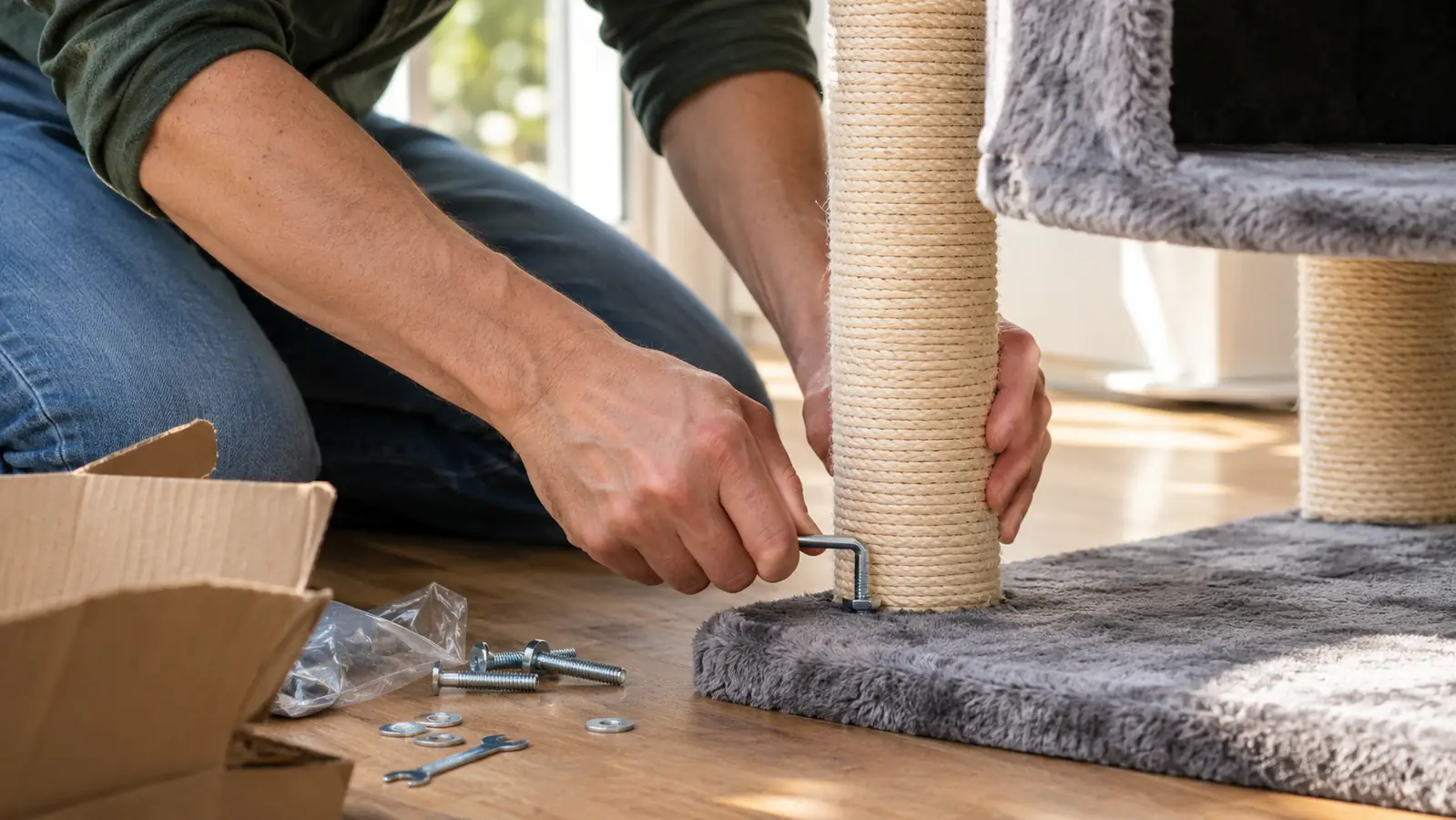
So look at the assembly before you look at the shape. The Yaheetech came with an illustrated manual, labeled parts, and every tool in the box. I put it together alone in about an hour with the included Allen key, on the living room floor, with the pieces laid out in the order the manual called for. That is less a selling point than a warning. If a tree arrives with one sheet of diagrams and no labels, you are going to guess, and a guess at the base is a guess at the whole thing.
Then put a reminder in your phone for six months out. Mine got one re-tightening at about the six month mark, a couple of bolts near the top that had worked a little loose. That is normal and it is not a defect. What is not normal is a platform that flexes when you press on it with your palm. If it flexes, keep the cat off it until you have found the bolt that is not doing its job.
Wood moves with the seasons, and a heated house in January is drier than the same house in July. That is why the check is worth repeating once a year whether or not anything feels loose. It takes four minutes with an Allen key, and it is the difference between a tower that lasts and a tower that ends up at the curb with a free sign taped to it.
Step 4: Run Your Hand Over the Scratching Surfaces
Sisal rope is the standard and it is the right one, but the wrap matters as much as the material. Run your hand down the post. If the rope is loose, or the gaps between the wraps are wide enough to catch a claw, a determined scratcher will have it off in a season. Tight, even wrapping with no gaps is what you are feeling for.
Moose is a hard scratcher. He is the reason there is a separate thirty two inch post at the end of my sofa, and he is the reason I care about this at all. The sisal on the tower has been scuffed down by more than a year of daily use and it is still intact, still wrapped, still doing the job it was wrapped for. That is what I want from a cat tree. Not a surface that survives a photo shoot, a surface that survives a cat.
Count the scratching spots, too. If the only wrapped post is down at the bottom, your cat will use it and then go find the sofa, because the sofa is at the height he likes. You want something to dig into at more than one level, and you want it near a platform he already uses so the two habits feed each other.
The covering matters for a different reason. Plush holds up to claws better than a loose woven fabric, and it vacuums clean without pulling threads. With two cats and a house full of grandkids, I run the vacuum over the platforms once a week, and the plush has not pilled or torn at the corners. A thin fleece cover would have been through by now.
Step 5: Choose the Spot Before You Open the Box
Sixty three inches tall, which is a little over five feet. That is tall enough that the cat on top is above your eye line when you walk past, and that is rather the point of a tall tower. It also means the spot has to be chosen with care, because once it is anchored to the wall you are not moving it on a whim.
Pick the place your cat already wants to be. In my house that is the big front window in the living room, which gets the afternoon sun and looks out on a street with more squirrels than sense. The Yaheetech tower sits in that corner, angled so the top perch faces the glass. Moose is up there most mornings. Pepper takes the lowest platform and the condo, which is exactly what I hoped she would do.
Then think about traffic. Do not put it in the middle of the path between the kitchen and the living room, because a cat coming down at speed and a person carrying a laundry basket are a bad combination. Corners and wall ends are better. Check the ceiling and any light fixture before you commit, as well, because a cat launching off a five foot platform has a surprising amount of reach.
What Else Helps
A cat tree solves climbing. It does not solve everything, and one piece of furniture will not keep a big cat content on its own. What has worked in this house is a small set of things that each do one job well, rather than one large thing expected to do all of them.
The scratching post at the end of the sofa gets used every morning before breakfast. It is thirty two inches of sisal, it stands where Moose was already scratching, and it took about a week for him to switch over from the sofa arm. If you have a hard scratcher, put a post exactly where the damage is happening, not across the room where you would prefer it to be.
For an older cat, height is not a kindness. Pepper has a soft donut bed on the bedroom carpet near the heat vent and she spends most of the afternoon in it. She also has the window perch on the front sill, which is low enough for her to reach without a jump. The tower is Moose's. That is allowed. Two cats do not have to share every piece of furniture equally, they each just need somewhere that is theirs.
And give the whole setup a look from the doorway before you decide you are finished. A cat tree is a piece of furniture in your living room whether you planned for it or not. Mine reads as part of the room rather than a piece of gym equipment, mostly because it is tucked into a corner instead of standing out in the floor. Placement does more for how these things look than any finish on the market.
The base measures 30.5 by 19 inches and the whole tower weighs a little over 34 pounds. That is the number that keeps a cat upright, not the height.
Start with the base and the anchor, then let him climb
Six levels, five platforms, a condo rated to 22 pounds and a hammock rated to 18. Assembled solo in about an hour with the Allen key that comes in the box.
Amazon Check Today's Price on Amazon →