
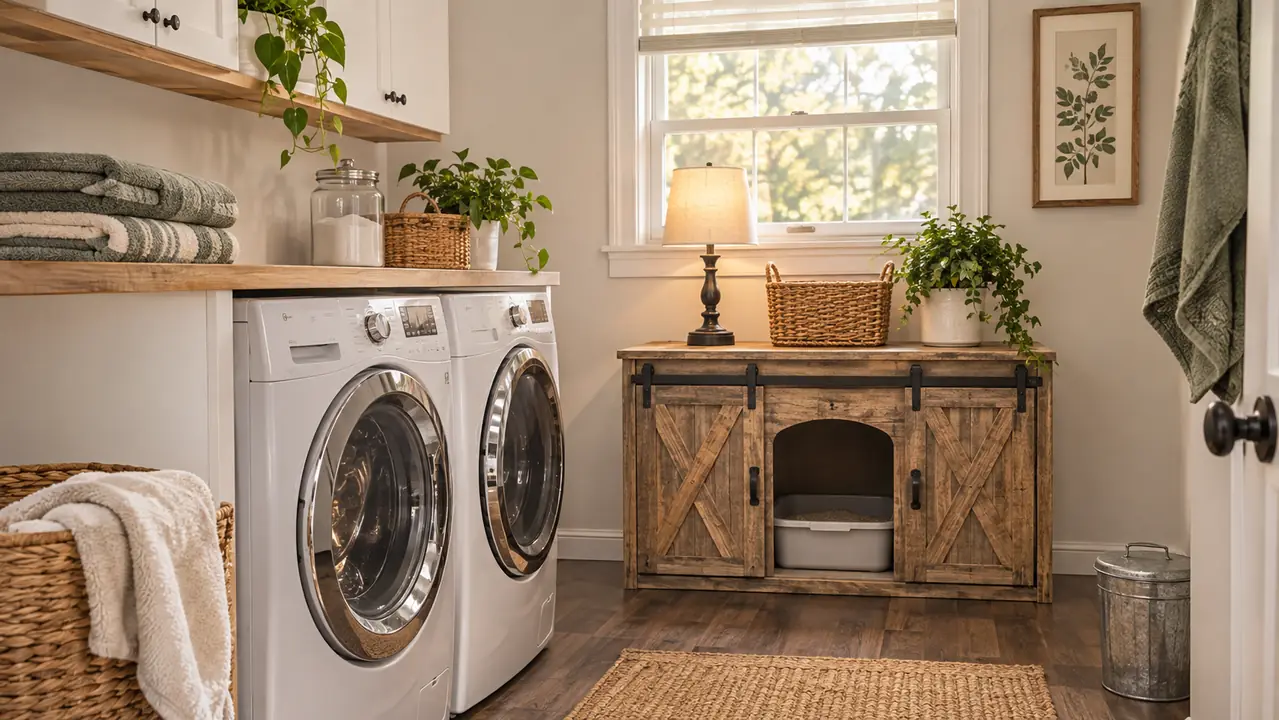
Here is how my laundry room used to look. Washer, dryer, a shelf of detergent, and a plastic litter pan sitting out in the middle of the floor like a guest who would not take the hint. Pepper is nine now and stiff in the hips, so she wants a low, quiet place to go. Moose is four, sixteen pounds, and treats an open pan the way a bulldozer treats a sandbox. I was sweeping that floor twice a day and still finding grit in my stocking feet at nine o'clock at night.
About a year ago I bought the Feandrea cat litter box enclosure, the end table version, and set it in that same laundry room. It is 31.5 inches long, 20.9 inches wide and 19.7 inches tall, which is furniture-sized rather than pet-store-sized. It has barn doors on the front and a rustic finish, and from the doorway it reads as a small cabinet instead of a cat bathroom. I am not going to pretend it solved everything, because it did not. But the pan stopped being the first thing you see when you come in from the garage, and that alone was worth the afternoon.
Twenty minutes with a screwdriver, and the pan disappears
The Feandrea enclosure arrives flat with labeled parts and the key you need. Measure your wall and your cat's pan first, then build it once, in the room where it lives.
Amazon Check Today's Price on Amazon →Step 1: Measure the Room Before You Measure the Enclosure
The first mistake I made was ordering from the picture. A laundry room is a working room, and the wall space is already spoken for by things that do not move: the dryer vent, the hot and cold taps, the outlet the washer is plugged into, the door that swings inward. The Feandrea unit is 31.5 by 20.9 by 19.7 inches and weighs around 35 pounds empty, so it is not a piece that slides around. Wherever you set it is where it stays.
So walk the room with a tape measure and lay a rectangle of painter's tape on the floor at that size. Then stand back and open the laundry room door all the way. Then crouch down to cat height. The barn doors need room to swing out, and you need room to get a scoop in and a bag out without doing a squat against the side of the dryer.
Two numbers matter more than the outside footprint. The inside compartment is 19.8 by 19.8 by 18.3 inches, so measure the pan you already own and hold those numbers against it. And the top is rated to hold up to 66 pounds. That is plenty for a lamp and a basket of supplies. It is not enough for the cast iron planter I had in mind when I started.
While the tape is still out, measure upward. I have a wire shelf above the unit, and the lamp that ended up on top is a small one because there are only a few inches of clearance under that shelf. Also decide where the litter itself lives before you commit. A big bag has to sit somewhere in that room, and if it sits on the floor in front of the doors you will be moving it twice a day for the rest of your life. Mine lives in a basket on top, and the refill jug goes under the utility sink, which is a corner I had forgotten existed.
Step 2: Put It Where the Cat Wants It, Not Where You Want It
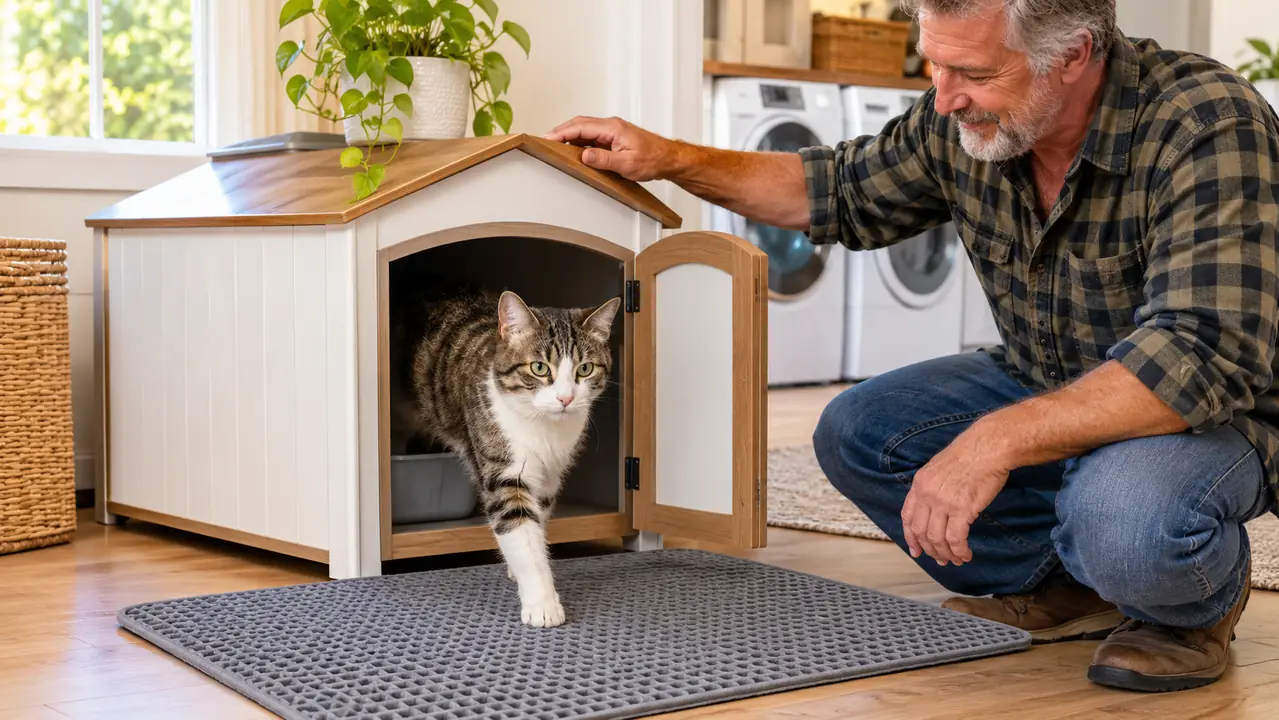
I put the first pan next to the dryer because it was convenient for me. The dryer thumps. Pepper quit the box for four days and I found out why when I ran a load of towels and watched her leave the room. A litter box in a laundry room works when it sits at the quiet end, away from the machine that shakes and the door that bangs.
The second thing is the door. The enclosure has an opening on one side and a solid end on the other. Point the opening into the room, toward the light and toward the direction your cat already comes from, not into a corner where the cat has to back out. Moose likes to see out while he is in there. That is a cat thing, not a design flaw.
Pepper is nine and does not jump anymore, so everything about this setup is at floor level and one step. That is why I did not put it on a riser or inside a closet with a lip to step over. If your cat is older or heavy, that is the whole argument for an end table over a cabinet with a hole cut in the top.
A word about the earlier attempt, because it cost me a week I would like back. Before the Feandrea unit, I tried a plain covered pan tucked into the corner behind the laundry room door. Pepper used it twice and then started going on the bathmat in the hall. What I learned the hard way: a cat wants to see out while she is in there, and she does not want her only exit pointed into a corner. When I pulled that covered pan out from the wall and gave it a clear line into the room, she went back to it the same night. That experience is the whole reason I chose an enclosure with a door on one face and a solid panel on the end, rather than a cabinet with a hole cut in the top.
Step 3: Assemble It in the Room, or Right Outside the Door
The Feandrea enclosure ships flat, in one carton, with labeled parts, an accessory kit and instructions. Mine took about twenty minutes with the included key and a screwdriver, and I am sixty-six and did it alone on a Sunday afternoon. The panels are particleboard and MDF, so they are heavy enough to feel solid and light enough that one person can handle a panel.
Build it in the laundry room if you have the floor space, or in the hall right outside the door. Do not build it in the garage and try to carry it through the kitchen. A 35 pound box with swinging doors on the front is an awkward shape, and you will chip a corner on a doorframe.
Two habits from a woman who has assembled a great deal of flat-pack furniture. Leave every screw a half turn loose until the whole piece is square and sitting flat, then tighten everything down. And put an old towel under it while you work. Laminate scratches, and you will be dragging panels around more than you expect.
Step 4: Fit the Pan Inside and Set Up the Entry
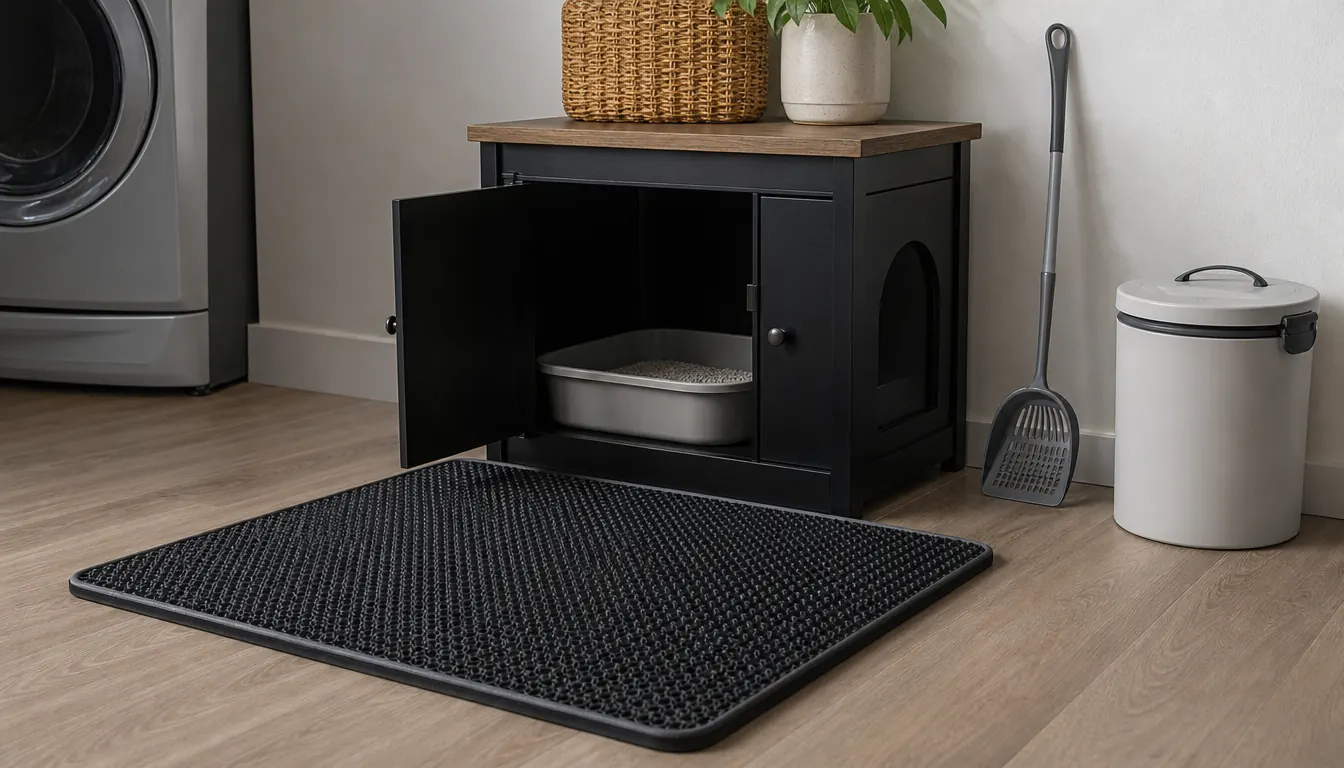
The compartment is 19.8 by 19.8 by 18.3 inches. A standard pan fits with room to spare. The oversized high-sided pan I had in the garage did not, so I measured and bought one that did. A pan that fills the compartment wall to wall is a nuisance to pull out for a full change, so leave yourself a couple of inches of play.
Litter depth is a personal matter for cats. Moose digs to the bottom, so I keep his a little deeper at the back. What I stopped doing is lining the inside with a plastic liner that bunches up at the doorway. That liner is what made Pepper refuse the box for two days in the first week, and it was not the enclosure's fault.
The top holds a lamp and a basket of supplies in my house, and both cats use the box daily a year on. It cut the scatter on the floor noticeably, not completely. If you want the honest version, the scatter went from twice a day to about once a week, and most of what is left comes out on their paws. No enclosure on earth stops that.
Litter choice matters more inside an enclosure than it ever did in an open pan, and nobody warned me about that. I use a clumping clay and keep the depth at about two inches, because Moose digs and a deep box just means litter over the lip. What I stopped buying is the very fine, dusty litter. In a closed space that dust hangs in the air, it coats the inside of the compartment, and it settles on the underside of the top where you will not see it until you pull the whole thing out. A coarser litter tracks a little more on the way out, but the inside of the box stays cleaner between changes. I empty and wash the pan every two weeks and wipe the inside walls with mild soap and water. Not bleach. The smell of the cleaner is what keeps a cat out of a box, and I learned that with a bathroom sponge and a very stubborn cat.
Step 5: Deal With the Smell and the Laundry Itself
An enclosure hides the sight of the box and holds some of the smell in with it. A laundry room is already a damp, linty place, so you have to be deliberate about it. Scoop once a day, which takes about a minute when the pan is below waist height and you are not crawling into a cabinet. Change the litter on a schedule instead of when it occurs to you.
Do not push the unit up against the dryer vent. Mine sits a good foot clear, and I check the vent hose every few months, because a blocked vent is a fire risk and a litter box is a fine place for lint to hide. If your laundry room runs humid, leave the door cracked after a wash day. Particleboard and MDF do not enjoy standing moisture, and neither does clumping litter.
One thing nobody tells you about putting furniture in a laundry room. The top becomes a surface. I fold towels on mine, which is not what it was sold as, but it is what happens in a house where the laundry room is also a hallway. That is the reason the thing has earned its footprint instead of feeling like a box I tolerate.
Here is the honest limit of the whole idea. An enclosure with a door on it is not a filter. On a humid July afternoon out here, with a load of towels going in the dryer and the utility room door shut, you can smell the box when you walk in. What fixed it for me was the same thing that fixed it in the open-pan days: a daily scoop, a bag that goes out to the bin rather than sitting beside the box, and propping that door open for an hour after a wash day. I also keep a small open jar of baking soda on the shelf behind the unit, which may be doing nothing at all except making me feel better, and I would rather tell you that plainly than sell you a system.
What Else Helps
A mat in front of the door does more for scatter than anything else you can add. Mine is a waffle-texture litter mat, and it catches what comes off their paws on the way out. Rinse it in the utility sink rather than the washing machine, unless you want your washer to smell like the box.
A second pan elsewhere in the house is worth thinking about with two cats. Two cats and one box is a compromise, and the usual advice is one box per cat plus one, which in a one-story ranch means the laundry room plus a plain pan in the hall bathroom. Also worth the money: a scoop with a long handle, a small lidded bin beside the box for the daily scoop, and an enzymatic cleaner for the one spot on the carpet where somebody missed.
And if you have small grandchildren who visit, the barn doors are the practical part. The pan is behind a door instead of out in the open, which means a toddler is not going to find it before you do. It is not a lock. It is a door, and in my house that has been enough.
It did not end the scatter. It took it from twice a day to about once a week, and the pan stopped being the first thing you saw coming in from the garage.
A year in a working laundry room, and I would buy it again
Two cats, a lot of towels, and one small room. Measure your wall and your pan first, then build the Feandrea enclosure once and stop thinking about it.
Amazon Check Today's Price on Amazon →