
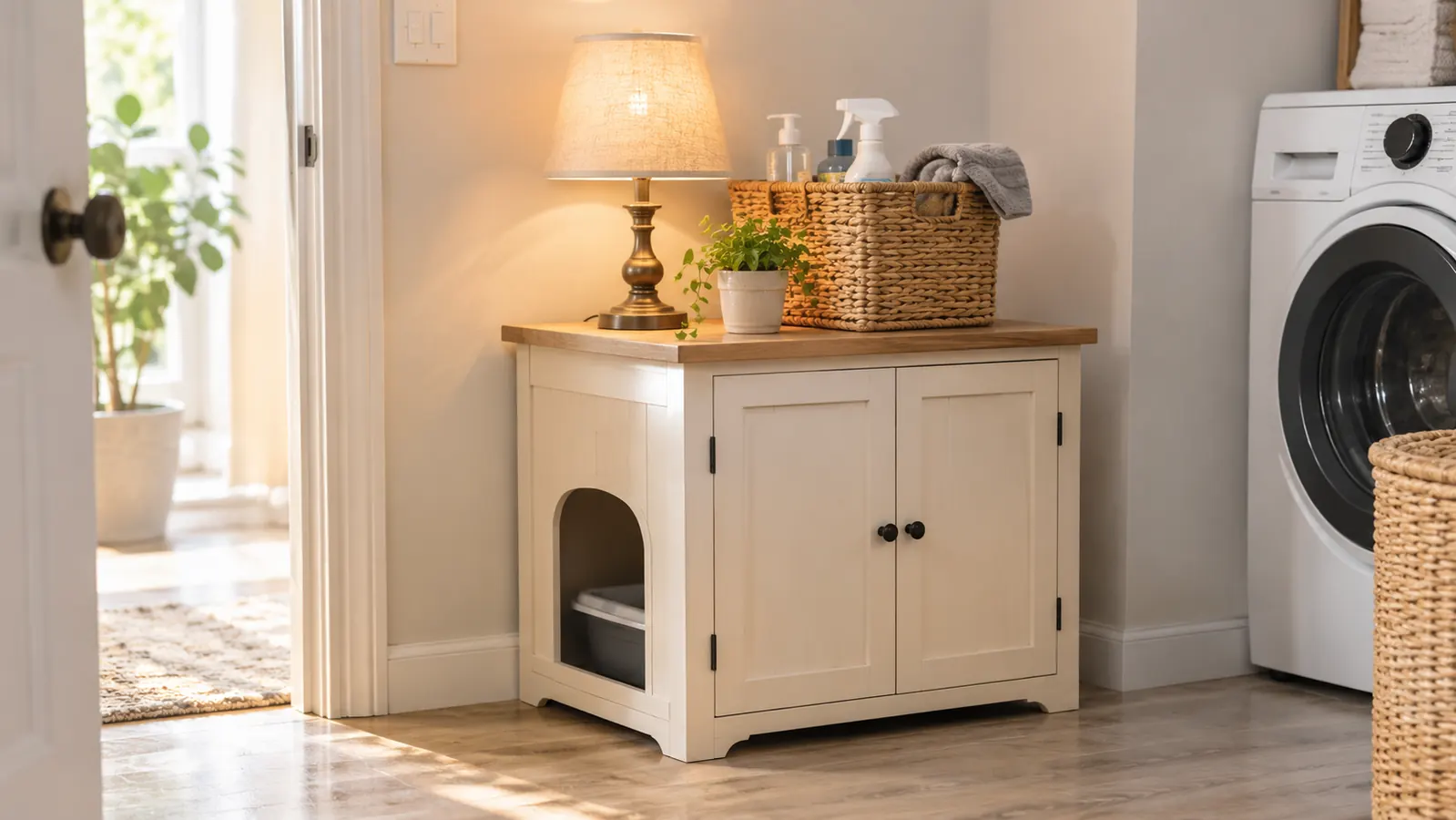
An open litter pan sat in my laundry room for years and I told myself it was fine. Then the grandkids came for a week, my daughter-in-law walked past the laundry room door, and said, pleasantly, 'Oh, so that is where it is coming from.' Nothing unkind about it. She was right. I had stopped smelling it years ago, which is its own kind of problem. I bought the Feandrea litter box enclosure about a year ago, put it where the pan had been, slid the pan inside, and set a lamp on top because a flat top in my house will hold something within a day. Here is what actually changed, what did not change, and the parts of an open pan I still miss.
The short answer before the long one. The Feandrea enclosure is better at the two things that bothered me most: litter tracked down the hallway, and a box sitting in plain sight. An open pan is better at nearly everything else, and everything else is convenience. Scooping, washing, dumping, and the fact that a plain pan costs almost nothing and asks nothing of you. Neither answer suits every cat. A young, healthy, easygoing cat does not need furniture built around his box. A nine-year-old with stiff hips, and a laundry room two steps from the kitchen, is a different household. I have one of each cat right now, so I have opinions about which one is getting the better deal.
| Feandrea Enclosure | Open Litter Pan | |
|---|---|---|
| Litter scatter | Walls and a doorway keep most of the kick-out inside the compartment | Litter lands wherever the cat aims, then travels on paws |
| Sight and smell | Hides the box completely, holds odor in, and holds it in for you when you open the doors | Visible from the hallway, and the smell has nothing to slow it down |
| Scooping | Open the front doors and reach into a 19.8 x 19.8 x 18.3 inch compartment | Nothing in the way at all |
| Emptying and washing the whole box | Lift it out through the doorway, then wipe down the inside of the cabinet too | Carry it to the tub and hose it out |
| Floor space | 31.5 x 20.9 inches of floor, but the top becomes a shelf or an end table | Smaller footprint and nothing gained above it |
| Big cats | The compartment fits most pans; a very large cat turns around with less room | Any size cat, any size pan, no walls |
| Build and hardware | Particleboard and MDF, top rated to hold 66 pounds, two year warranty | Molded plastic, no moving parts, no warranty worth mentioning |
| How it looks in the house | Reads as a small cabinet and fits a laundry room or a hallway | Reads as a litter box, because it is one |
| Assembly | About twenty minutes with a screwdriver and labeled parts | Nothing to assemble, it comes ready to fill |
| Pickiness | Some cats refuse an enclosed box for a week or forever | The box your cat already trusts |
How I Compared Them
I did not set up a laboratory. I did something less tidy and more useful. I put the old open pan back in the same laundry room spot for two weeks, then swapped the Feandrea enclosure back in for two weeks, and swept the same square of laminate at the same time every evening with the same dustpan. I counted how many mornings I smelled the box at the laundry room door before I saw anything else. I also watched the cats, which turned out to be the more important half of the comparison and the half I could not have guessed at from a product page.
I also wrote the dates on the back of an envelope, which is still on the shelf above the dryer, because I have learned that my memory of a thing I want to be true is not reliable. The first stretch ran from a Monday to a Sunday and the second stretch the same, so each got a full weekend in it, and weekends are when this house is busiest.
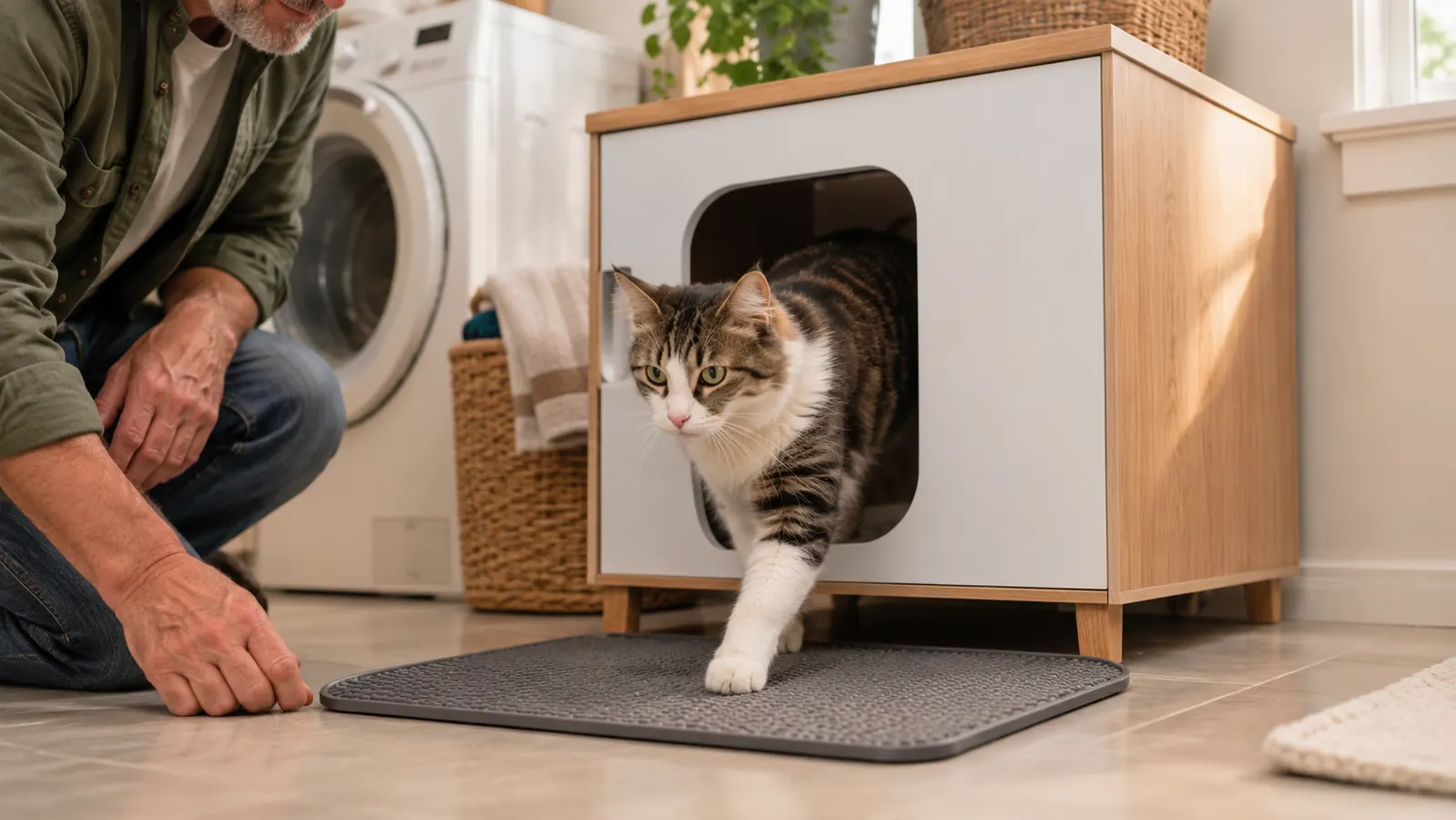
Pepper is nine, around eleven pounds, and stiff in the hips. Moose is four, sixteen pounds, and built like a sack of oranges. Pepper walked into the enclosure the first afternoon like she had been waiting for somebody to offer her a room of her own. Moose treated the doorway as a puzzle for about a day, then solved it and started using the top of the cabinet as a launch pad, which I have opinions about. Neither cat refused it. That is luck as much as design, and I know perfectly well that plenty of cats would have sulked for a week and left me a message on the rug.
What You Get With the Feandrea Enclosure
It is a piece of furniture that happens to hold a litter box. Particleboard and MDF, 31.5 inches long by 20.9 inches wide by 19.7 inches high, about 35 pounds on its own, and the top is rated to hold 66 pounds, which is why a lamp and a basket of litter supplies live up there now instead of on the dryer. The inside compartment is 19.8 by 19.8 by 18.3 inches and my pan sat in it with room to spare on all four sides. The front barn doors open wide enough to reach in with a scoop without contorting your shoulder, which at my age is not a small thing. It arrived with an accessory kit and instructions, and I had it together in about twenty minutes with a screwdriver. The warranty is two years and I have not needed it.
The weight matters more than it sounds like it would. Thirty five pounds empty, plus a loaded pan inside, is heavy enough that it does not skate across the floor when a big cat launches out of it, and still light enough that I can drag it out six inches to sweep underneath by myself. I am sixty six and I do not lift things I do not have to lift. If you have a bad back, get somebody to carry the box in from the porch, then assemble it where it is going to live.
The cabinet sits flat on the laminate without a wobble. I checked it with a level, because I check everything with a level, and I have put together enough flat pack furniture in this house to know that a piece which rocks on the floor will rattle every time a cat jumps off it. The hardware came in a labeled bag, with the parts sorted by step, which is not something I expected and which saved me the usual ten minutes of sorting screws onto a dish towel.
Where the Feandrea Enclosure Wins
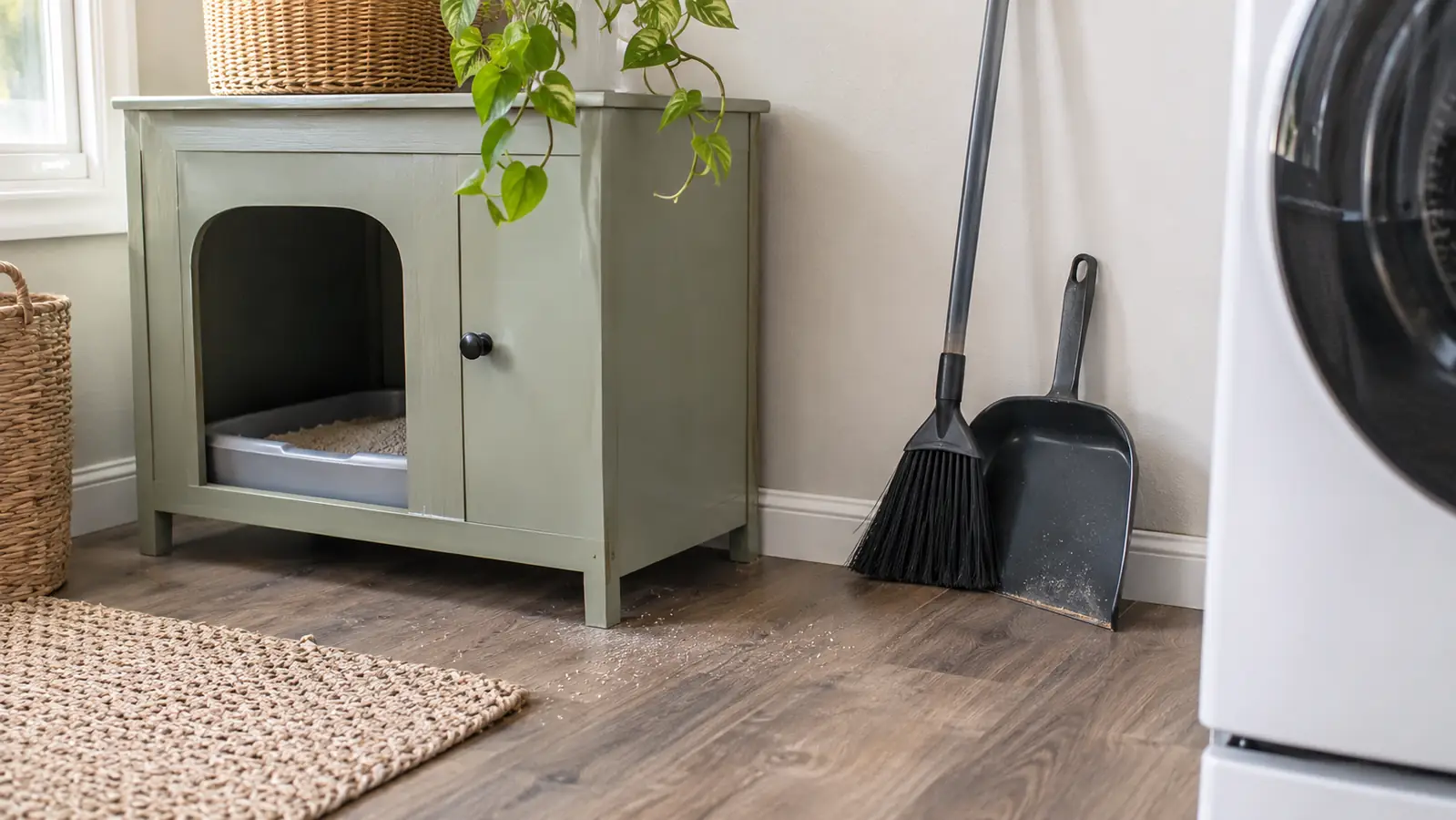
Scatter is the win, and it is not close. With the open pan, I swept a light dusting of litter off that floor every single evening, and I could track it down the hallway on my socks if I was not paying attention. With the enclosure, the litter that gets kicked stays inside the compartment and hits the wall instead of the floor. I sweep a few specks every third day now. Not none. I want to be clear about that, because a floor with a litter box in the house is never truly clean. But the difference between sweeping daily and sweeping twice a week is the difference between a chore and an afterthought, and I will take it.
To put a number on it, in the open pan weeks I filled a good part of a dustpan every night. In the enclosure weeks the dustpan had a thin line of grains in the bottom and I often skipped a night entirely. The mat in front of the doorway catches the rest, and that mat, which I bought for the open pan years ago and had nearly thrown out, finally has a job worth doing.
The second win is the one nobody puts on a spec sheet. My laundry room is on the way to the kitchen. Before, anybody walking through saw the box, and I could see it from the hallway while I was setting the table. Now they see a small cabinet with a lamp on it. The room looks like a room instead of a utility closet that gave up. That sounds like vanity and maybe it is, but I have lived in this house for forty years and I have earned the right to not look at a litter pan while I eat.
The floor by the laundry room door went from a light dusting of litter every single day to a few specks I sweep up every third day. Not none. But close.
Where an Open Pan Wins
Scooping is easier with an open pan, and I am not going to pretend otherwise. With the pan out in the open you walk up, lean over, and you are done in fifteen seconds. With the enclosure you open two doors, and the doorway means you are reaching in and slightly down rather than straight down. It is not difficult. It is just one more step, twice a day, forever. Dumping and washing the whole box is worse. You lift a full pan out through the doorway, carry it to the tub, and then you also wipe down the inside of a cabinet that has been holding a litter box for a month. An open pan gets hosed out and that is the end of it.
On an ordinary Tuesday it is nothing. On the Saturday I do the full change, it is twenty extra minutes: lift the pan out, dump it in the bag, wipe the inside of the cabinet down with a vinegar and water rag, let it dry while I wash the pan, then put it all back. Twenty minutes once a week is not a hardship and I want to be fair about it, but it is more than nothing and you should know it going in.
Then there is the honest part that enclosure reviews tend to skip. An enclosed box holds odor in, which is the point, but it also holds it in for you. When I open those doors on a Sunday morning before I have scooped, I get the full smell in the face in a way I never did with the pan out in the open. The room stays fresher and my nose takes a hit at scoop time. If you are sensitive to smells, that trade is worth thinking about before you buy. And cost is simple arithmetic: an open pan is a fraction of the price, and the enclosure does not replace the pan, it just sits around one.
If the litter trail on your floor is the thing that finally wore you down, this is the piece that ended mine.
Thirty one and a half inches of particleboard and MDF with barn doors on the front, a compartment that fits most standard pans, and a top rated for 66 pounds so the floor space pays you back. About twenty minutes to assemble. Two year warranty.
Amazon Check Today's Price on Amazon →Who Should Buy Which
Buy the Feandrea enclosure if the box is visible from a room you actually live in, if you are tired of sweeping litter off the floor every night, or if you have an older cat who wants a quiet corner to herself. It also suits a house like mine, where the laundry room doubles as the pass-through to the kitchen and the top surface was going to get used for something anyway. It suits a two cat household fine, as long as you keep scooping. Furniture around a dirty box is still a dirty box, just a better looking one.
Keep the open pan if your cat is a nervy one who has used the same box for years and does not like change. Keep it if you have a very large cat and a very large pan, because the compartment is generous but it is not a barn. Keep it if you have trouble bending and reaching, or if the box lives somewhere nobody sees, like a basement or a spare bathroom with a door that closes. In those cases you would be spending money to solve a problem you do not have, and I would rather you spent it on something else.
The Part I Would Change
One thing I would tell the folks at Feandrea if they asked, and they have not. The doorway is the whole design, and it is fixed. I cannot raise or lower anything about it, so I cannot make the reach any easier for a tall person or a short one. It works for me at five foot four and it works for my son at six foot one, but it is what it is. The other thing is the interior. It fits most pans, and mine fit fine, but if you own one of the jumbo covered pans, measure it before you order. Measure the pan, then measure the compartment, and believe the smaller number.
A year in, the lamp is still on top of it and the floor by the laundry room door is still mostly clean.
That is the whole review, really. It hides the box, it slows the scatter down to almost nothing, and it holds a lamp. If that sounds like the laundry room you want, go measure your pan and then go look at the current price.
Amazon Check Today's Price on Amazon →