
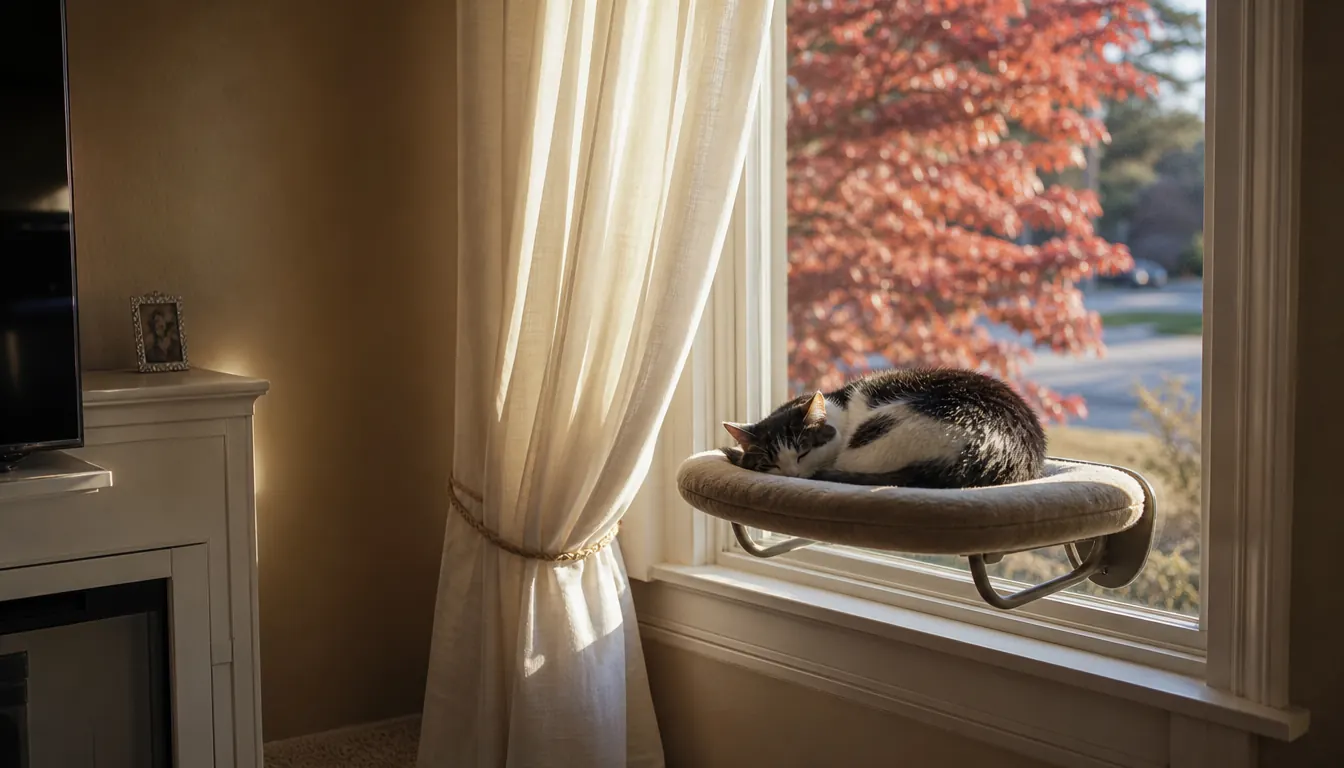
Every cat I have lived with has picked one window and treated it like a television. In my house it is the big front window in the living room, the one that takes the afternoon sun and looks straight into a maple tree full of birds. Pepper, my nine year old tabby, spent years watching it from the back of the sofa. That meant she was on the sofa and I was sitting somewhere else. Eight months ago I hooked a Zakkart window perch onto that sill, and the argument ended.
If you have tried a suction cup hammock, you already know how that story goes. It holds for a week, then it lets go at two in the morning and the cat never trusts it again. The other option is drilling a bracket into the window frame, which I was not about to do to a fifty year old window I had just finished painting. A perch that hangs on the sill you already own sits between those two. It needs no screws, no cups and no tools. It does need one thing from your window, and that one thing is what most people get wrong.
Pepper claimed hers before I finished setting it down
The Zakkart window perch hangs on the sill slot your window already has. No suction cups, no drilling, and a bed that comes off for a cold wash. Check the slot depth first, then take the measurement twice.
Amazon Check Today's Price on Amazon →Step 1: Measure the slot in the window, not the window itself
This is the step that decides everything else, and it is the one people skip. The perch hangs by hooking down into the channel where the lower sash slides, and the listing calls for a slot at least half an inch deep. Not half an inch of sill. Half an inch of slot. Get a ruler and push it down into the gap between the sash and the frame until it bottoms out. On my 1970s double hung windows that channel is deep and forgiving. On the newer vinyl windows in my daughter's house the sash sits almost flush and there is barely a groove at all.
If your window is flush, stop here. No amount of adjusting will make a perch hang on a slot that is not there, and the Zakkart perch is not the right piece for that window. A shelf screwed into studs beside the window is the honest answer for a flush frame, and it is a bigger project than this one. Measure first, buy second.
Take a second measurement while the ruler is out. The perch footprint is about 26 inches long and 15 inches wide, and the whole thing weighs under four pounds. Your sill needs enough flat surface to sit that footprint down, and there needs to be nothing above it in the way, such as a curtain rod hung low or a deep blind valance that stops the frame from seating.
Step 2: Pick the window your cat already watches
Do not pick the window you think is prettiest. Pick the one the cat already sits near. That was easy for me, because Pepper had been crowding the back of the sofa for years to see out the front. Cats want a view with movement in it, so a window facing a street, a feeder, a hedge or a tree gets far more use than one looking at a fence six feet away. Sun matters, but only for part of the day, and a perch in a bright window facing nothing will sit empty.
Height matters more than people expect, and it matters differently for different cats. Pepper is nine and a little stiff in the hips now, so she wants a perch she can reach with one easy jump from the sofa arm, and hers sits directly above that arm. Moose, who is four, sixteen pounds and climbs everything, would rather be high up. The perch goes where the sill is, so the furniture around it does the work. Put a stool or a sturdy side table in reach if the jump is too far for your cat.
One thing I did with mine that I would do again: I looked at the window from the doorway before I committed. A perch on a sill is furniture in your living room, and it should look like it belongs there. Mine reads as part of the window rather than something bolted on, which is more than I can say for the wire shelf I tried first.
Step 3: Seat the frame on the sill and hook it down
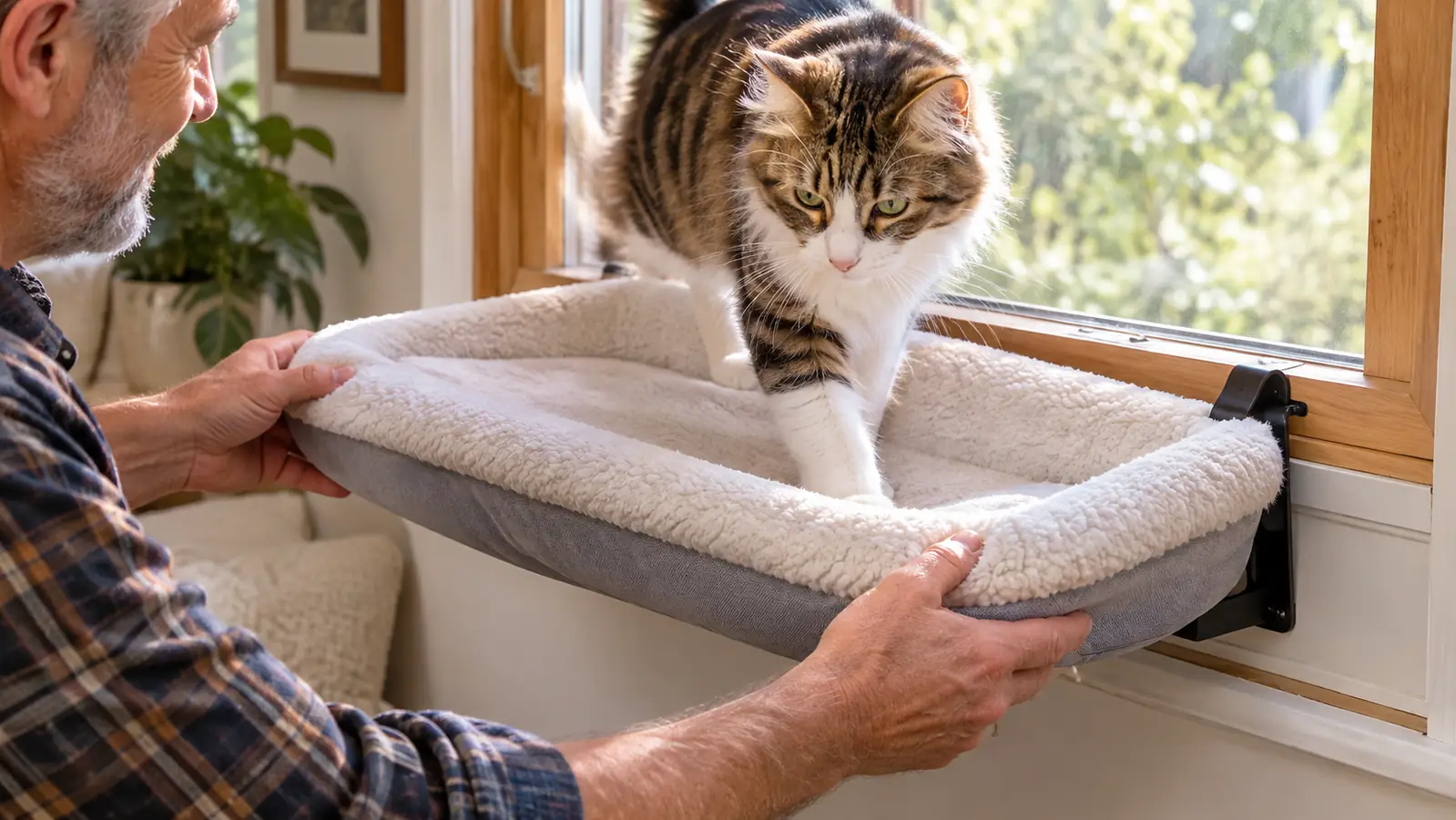
Mine arrived as one piece, so there was nothing to assemble with a screwdriver and nothing to read twice. I set the frame on the sill, lined the hook up with the channel, and pushed down until it seated. Then I rocked it side to side with my hand, hard, the way a sixteen pound cat will when he lands. It did not lift.
Do that test yourself before a cat ever gets on it. Push down on the front edge, then lift gently at the front corners. You want the frame to feel like part of the window. If it rocks, the hook is not fully down in the slot, or the slot is shallower than you thought and you are back at step one.
Leave the sash in the position it will normally sit in for the first day, so nothing shifts while a cat is getting used to the new thing in the window.
The perch is rated to forty pounds. Moose is sixteen and lands like a dropped sack of flour, and eight months in the frame has not moved a quarter inch.

Step 4: Fit the bed and check it under real weight
The bed attaches to the frame with a sewn in sleeve rather than a zipper, which is a detail I did not know I cared about until I owned it. Zippers on cat furniture let go at the pull, and once one goes the cushion slides around on the frame. Eight months in, with a cat on it most sunny afternoons, the bed has not shifted a fraction of an inch.
The XL bed measures 26.4 by 15 inches, and the perch is rated to hold up to 40 pounds. Pepper at eleven pounds barely dents it. Moose at sixteen fits, though he takes most of the width and shares it about as graciously as a teenager shares a phone. Two cats this size on this perch is a standoff, not a cuddle, so do not count on it as a two cat bed.
Washing is the part that matters in a house with real cats. The bed comes off the frame, goes in cold, takes a low tumble dry, and goes back on the sleeve. I have done it three times and it comes out flat and goes back on the same as it went on the first day.
Step 5: Show your cat what it is, then get out of the way
I lifted Pepper onto the perch the afternoon I hung it and she stayed for two hours. That is not a training triumph, that is a cat who had been waiting for someone to notice. Moose was different. He jumped up, decided it was narrower than the top of the cat tree, and got down. What fixed it was pulling a chair beside the window so he could step across rather than leap. He uses it now, mostly in the morning when the light comes in at an angle.
If your cat ignores it for a week, do not move the perch around. Cats are slow to trust new furniture, and a perch that gets moved three times is a perch that never gets used. Put a shirt you have worn or a blanket the cat already sleeps on in the bed for a few days, keep the glass clean, and give it a fortnight. Keep your own chair pulled up near it too. Half of why Pepper likes her spot is that it sits at eye level with me.
And do not hover. The first time Moose got on it I stood there watching like a hawk, and he got straight back down. I walked into the kitchen and he was up there before I came back.
Where This Perch Will Not Work
I would be doing you a disservice if I pretended this fits every window. It will not suit a flush vinyl sash, a casement window that cranks out, a sliding glass door, or a window whose lower sash is painted shut. It will not work if the sill is too narrow for the frame to sit flat, and it is a poor choice directly over a radiator or a forced air vent, because a cat will not stay where hot air is coming up at it.
The other limitation is the cat, not the perch. A sill perch is a shelf, and some cats do not want a shelf. I have a friend whose cat will only sit on paper bags on the floor, and nothing about well made cat furniture changes that. The Zakkart perch earns its place if your cat already watches a window. If your cat does not care about windows, no perch will teach it to.
What Else Helps
A perch on its own is a shelf. What makes the corner work is everything around it. The tall sisal scratching post at the end of my sofa sits about four feet from that window, and Moose uses it every morning on his way up. A cat with somewhere to stretch and scratch near the window settles faster.
A landing spot matters more than anything else for an older cat. Pepper is stiff in the hips, and the difference between a perch she uses and one she ignores is whether she has to jump or can step. A footstool, the arm of a sofa, a sturdy side table, any of those will do. I also keep a soft donut bed on the floor under the window for the days she wants the sun without the climb.
The cat tree in the corner matters too, more than I expected. Moose climbs it in the morning and settles on the perch in the afternoon, and giving him a place to go that is not the window is the only reason the perch is not a wrestling match. Keep the glass clean and the curtain pulled back. It sounds fussy until you watch a cat give up on a view because the window has a winter of film on it. And if that window takes hard July glare, a sheer panel on one side gives shade without blocking the view.
Eight months, one perch, one very possessive tabby
Measure the slot in your window first. If it is half an inch or deeper, the Zakkart perch hooks on in a minute and the bed washes in an afternoon. Then get out of the way and let the cat decide.
Amazon Check Today's Price on Amazon →